

Bridge Oncology Executive Insight
The CY 2027 OPPS Proposed Rule Could Redefine the Financial Future of Theranostics Programs
By: Jordan Johnson, MLS, MSHA
The Next Strategic Question: Does This Accelerate a Shift in the Site of Care for Theranostics?
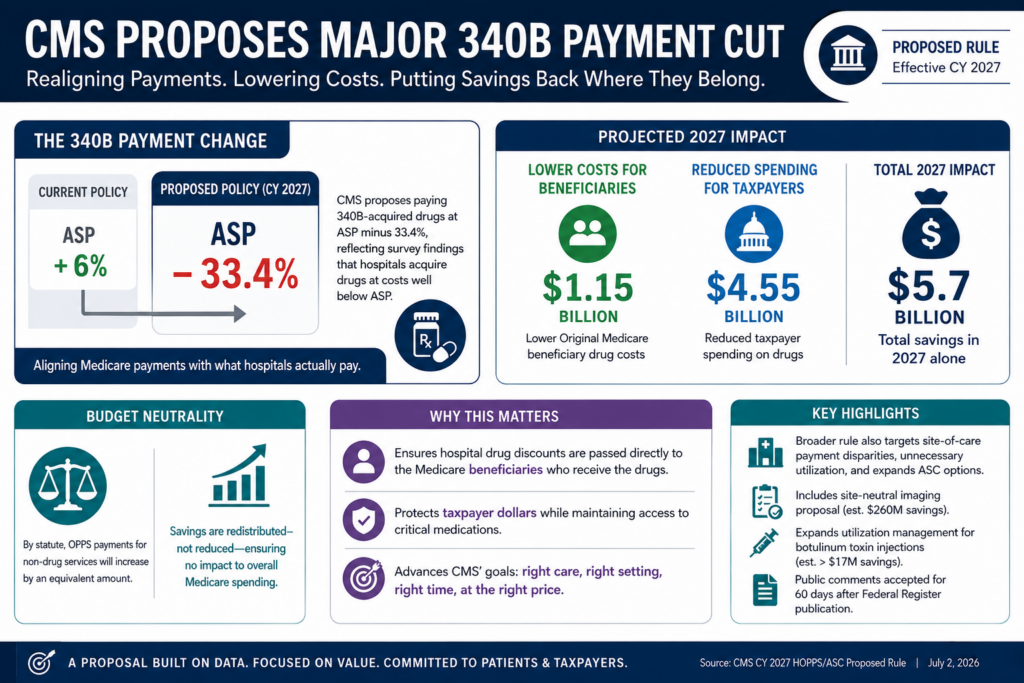
Perhaps the most overlooked implication of the CY 2027 OPPS Proposed Rule is not the reduction in 340B reimbursement itself. It is what that reduction could mean for where theranostics is ultimately delivered over the next decade.
Healthcare has seen this pattern repeatedly.
For years, CMS has pursued policies designed to move appropriate services into lower-cost settings. The gradual elimination of hundreds of procedures from the Inpatient Only (IPO) List and the steady expansion of the Ambulatory Surgical Center (ASC) Covered Procedures List fundamentally changed where surgical care is delivered. Procedures once viewed as hospital-only are now routinely performed in outpatient hospitals and ASCs because payment policy, clinical evidence, technology, and operational capabilities evolved together.
Theranostics may now be approaching a similar inflection point.
Today, the vast majority of therapeutic radiopharmaceutical programs remain hospital-based. That has made sense for several reasons. Hospitals possess the infrastructure required for radioactive materials handling, specialized pharmacy operations, radiation safety programs, imaging capabilities, multidisciplinary oncology teams, and Authorized Users. Just as importantly, many hospitals have benefited from the financial advantages created through the 340B Program, helping offset the substantial investment required to establish and sustain these programs.
The proposed reduction in 340B reimbursement changes part of that equation.
As the financial advantage of hospital-based acquisition narrows, the economic gap between hospital programs and community-based oncology practices begins to narrow as well. The question is no longer simply how much Medicare pays for a dose of Lu-177. The question becomes whether the historical financial advantages of delivering theranostics in a hospital remain sufficient to justify the higher operating costs associated with that environment.
Community oncology has consistently demonstrated its ability to adapt when reimbursement and clinical demand align. Over the past two decades, infusion therapy, advanced imaging, molecular diagnostics, and increasingly complex oncology treatments have steadily migrated closer to the patient. While theranostics remains operationally more complex than those services, market forces have a way of accelerating innovation.
This does not suggest that theranostics will suddenly move into every community oncology practice.
Significant barriers remain.
Delivering therapeutic radiopharmaceuticals requires radioactive materials licensing, radiation safety officers, specialized pharmacy handling, waste management, imaging integration, compliance with Nuclear Regulatory Commission or Agreement State requirements, and physicians who qualify as Authorized Users under applicable regulations. These are substantial operational hurdles that cannot be overcome simply because reimbursement changes.
However, healthcare history demonstrates that operational barriers rarely remain permanent when financial incentives evolve.
Technology vendors continue developing more efficient workflows. Pharmaceutical manufacturers continue investing heavily in theranostic platforms. Community oncology networks continue expanding their clinical capabilities. Private investment continues flowing into oncology infrastructure. As these trends converge, organizations that once viewed theranostics as achievable only within large academic medical centers may begin evaluating whether community-based delivery is both clinically feasible and financially sustainable.
The proposed 340B changes may not directly move patients out of hospitals—but they could remove one of the strongest financial reasons for keeping every treatment there.
Hospitals Must Compete on More Than Margin
If reimbursement advantages narrow, hospitals will increasingly compete on value rather than payment differential.
That means demonstrating measurable excellence in:
In many ways, this represents a healthy evolution of the specialty.
- Clinical outcomes
- Multidisciplinary coordination
- Patient selection
- Appropriate utilization
- Operational efficiency
- Time from referral to treatment
- Radiation safety
- Pharmacy integration
- Patient experience
- Access to clinical trials
- Long-term survivorship and follow-up
The strongest theranostics programs of the future will not simply administer radiopharmaceuticals. They will provide comprehensive precision oncology programs built around imaging, molecular diagnostics, multidisciplinary treatment planning, radiation oncology, medical oncology, pharmacy, navigation, and longitudinal patient management.
Organizations unable to clearly define that value proposition may find it increasingly difficult to justify the higher costs associated with hospital-based delivery.
The Organizations That Model First Will Have the Advantage
The most successful health systems will not wait for the Final Rule before evaluating their exposure.
Executive teams should already be asking difficult questions.
- What is our contribution margin per therapeutic dose?
- How much of our theranostics program depends on 340B economics?
- What does profitability look like under multiple reimbursement scenarios?
- How do commercial contracts compare to Medicare reimbursement?
- What percentage of our costs are fixed versus variable?
- Could portions of the patient pathway be redesigned to improve efficiency without compromising quality?
If community-based competitors enter our market, what differentiates our program?
These are no longer theoretical planning exercises. They are strategic questions that will shape capital allocation, physician recruitment, payer contracting, and oncology growth strategies over the next several years.
Why Bridge Oncology Is Different
At Bridge Oncology, we understand that theranostics is not simply another oncology service line—it is one of the most sophisticated intersections of clinical medicine, pharmacy, radiation oncology, nuclear medicine, reimbursement policy, regulatory compliance, finance, and operational execution.
Few organizations possess expertise across every component required to build and sustain a successful theranostics program. Our team does.
We work alongside hospitals, health systems, academic medical centers, and community oncology programs to evaluate every aspect of program performance—from pharmacy acquisition strategy and 340B financial modeling to radiation safety, workflow optimization, reimbursement, prior authorization, coding, compliance, physician alignment, capital planning, and executive financial strategy.
Our health policy expertise allows us to interpret complex CMS regulations before they become operational challenges. Our financial modeling capabilities quantify how reimbursement changes affect contribution margins, operating income, and long-term sustainability. Our operational experience helps organizations redesign workflows that improve patient access while reducing unnecessary cost. Most importantly, our clinical expertise enables us to align pharmacy, nuclear medicine, medical oncology, radiation oncology, imaging, and finance into a single, integrated theranostics strategy.
The proposed 340B changes are not simply about reimbursement. They are about the future structure of theranostics in the United States.
Organizations that understand that today will be the ones defining the next generation of precision oncology tomorrow.