

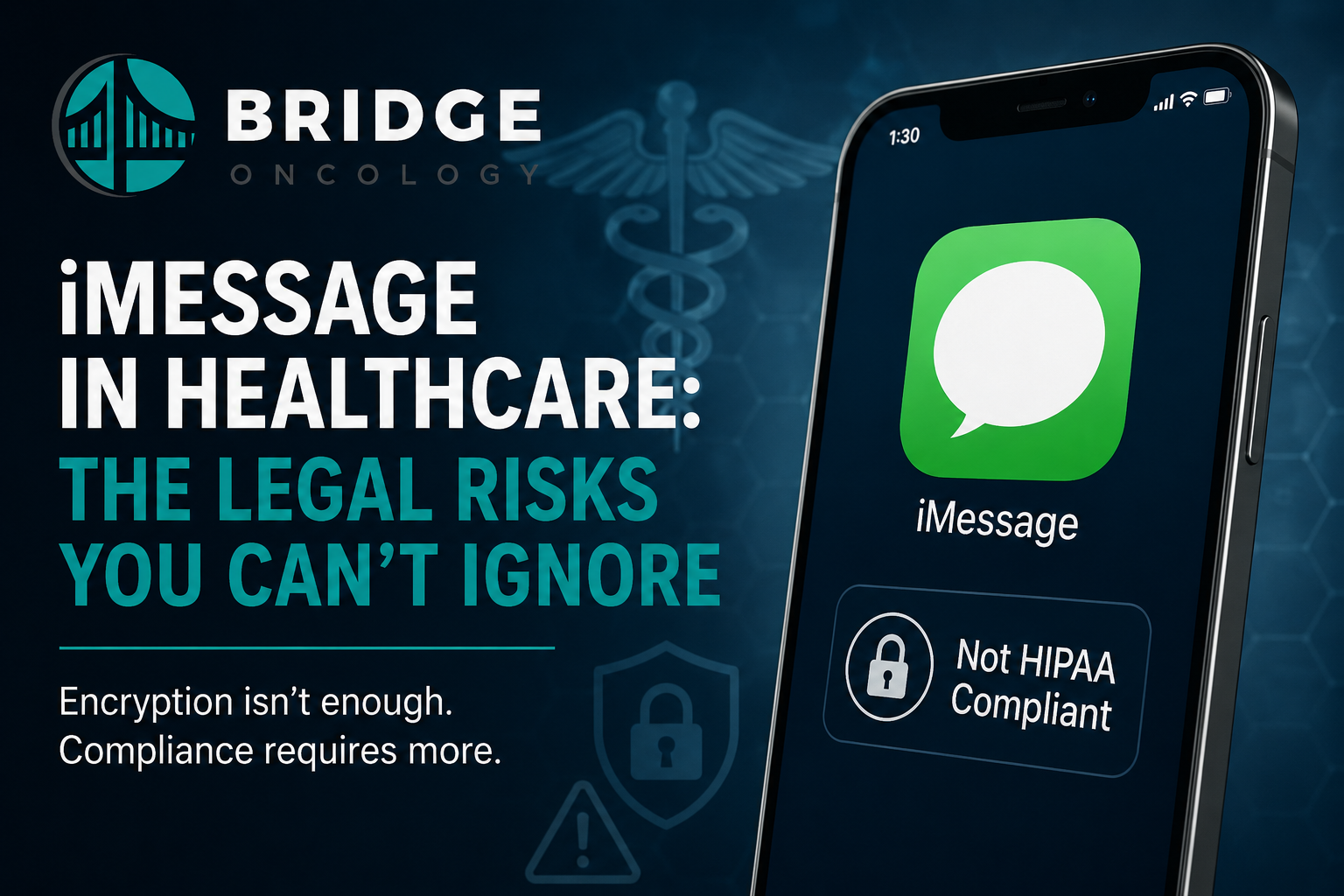
The iMessage Problem in Healthcare: Encryption Does Not Equal HIPAA Compliance
Healthcare professionals send thousands of text messages every day to coordinate patient care, answer clinical questions, and communicate with colleagues. Because Apple iMessage uses end-to-end encryption, many clinicians assume it is appropriate for transmitting Protected Health Information (PHI). Unfortunately, encryption alone does not make a communication platform HIPAA compliant. The issue is not whether iMessage is secure; the issue is whether it satisfies the legal, administrative, technical, and contractual requirements required under HIPAA. For most healthcare organizations, the answer is no.
Encryption Alone Does Not Meet HIPAA Requirements
HIPAA was never intended to be an encryption standard. Instead, it establishes a comprehensive framework requiring covered entities and business associates to protect PHI through administrative, physical, and technical safeguards. Encryption is only one component of those safeguards. Organizations must also implement appropriate access controls, workforce training, audit capabilities, incident response procedures, risk analyses, and ongoing compliance monitoring. Simply using an encrypted messaging application does not satisfy these broader obligations. The Department of Health and Human Services (HHS) has consistently emphasized that compliance depends on governance and risk management rather than a single security feature.
The Business Associate Agreement Is the Critical Missing Piece
One of the most significant compliance issues surrounding iMessage is the absence of a Business Associate Agreement (BAA). Under HIPAA, any vendor that creates, receives, maintains, or transmits PHI on behalf of a covered entity generally qualifies as a business associate and must execute a BAA defining its legal responsibilities for safeguarding that information. Apple does not offer a BAA for iMessage. Without this contractual relationship, healthcare organizations lack the legal assurances and allocated responsibilities required when PHI is transmitted through the platform. Regardless of how strong the encryption may be, the absence of a BAA creates a substantial compliance concern.
Healthcare Requires Governance, Not Just Secure Communication
Healthcare organizations must be able to demonstrate far more than secure transmission of data. They must maintain records showing who accessed patient information, when the information was viewed, whether messages were forwarded, how long communications were retained, and whether administrators can retrieve or audit those records during an investigation. Organizations also need the ability to remotely revoke access, wipe data from lost or stolen devices, preserve communications for litigation, and enforce retention policies. Consumer messaging platforms such as iMessage were never designed to provide these enterprise governance capabilities, making them difficult to defend during regulatory reviews or legal proceedings.
Personal Devices Introduce Significant Organizational Risk
The widespread use of personal smartphones creates additional compliance challenges. Messages containing PHI may synchronize across multiple personal Apple devices through iCloud. Notifications displaying patient information may appear on lock screens where family members or others can view them. Patient photographs may automatically upload into personal photo libraries or cloud backups. When employees leave an organization, years of clinical communications may remain stored on personal devices outside the organization’s control. Even organizations that implement mobile device management solutions often cannot fully govern consumer messaging applications in the same way they can dedicated healthcare communication platforms.
Clinical Text Messages May Become Legal Evidence
Many healthcare professionals overlook the legal implications of text messaging. Communications regarding diagnosis, treatment decisions, care coordination, or clinical recommendations may become discoverable evidence during malpractice litigation, government investigations, or regulatory audits. If those communications occur through personal iMessage conversations, organizations may have no centralized archive, no formal retention policy, and no reliable method for producing complete records when requested. The inability to preserve or retrieve clinical communications can create legal exposure that extends well beyond HIPAA compliance.
Industry Practice Does Not Establish Compliance
One of the most dangerous assumptions in healthcare is that widespread use somehow creates regulatory acceptance. Many clinicians have exchanged patient information through iMessage for years, but common practice does not determine compliance. HIPAA requires organizations to perform documented risk analyses, implement appropriate safeguards, manage vendor relationships, and continuously monitor security risks. Regulators evaluate documented compliance efforts, not the popularity of a particular communication tool. The fact that “everyone uses it” offers little protection during an Office for Civil Rights (OCR) investigation.
Healthcare Organizations Need Enterprise Communication Platforms
Organizations that routinely communicate PHI should utilize enterprise messaging platforms specifically designed for healthcare. These platforms typically provide Business Associate Agreements, centralized administrative oversight, comprehensive audit logs, role-based access controls, multi-factor authentication, remote device management, message retention, legal hold capabilities, and integration with electronic health records. These features allow organizations not only to protect patient information but also to demonstrate compliance during audits, investigations, and litigation.
Thoughts and Direction
Apple iMessage is a secure consumer messaging application, but security alone does not satisfy HIPAA. Compliance requires documented governance, contractual accountability, administrative oversight, audit capabilities, retention policies, and the ability to manage PHI throughout its entire lifecycle. Healthcare organizations should carefully evaluate whether any consumer messaging application aligns with their HIPAA obligations before allowing it to be used for patient communications. In today’s regulatory environment, the question is no longer whether a message is encrypted. The question is whether the organization can demonstrate compliance if regulators, auditors, or attorneys ask how that message was protected, managed, retained, and governed.