

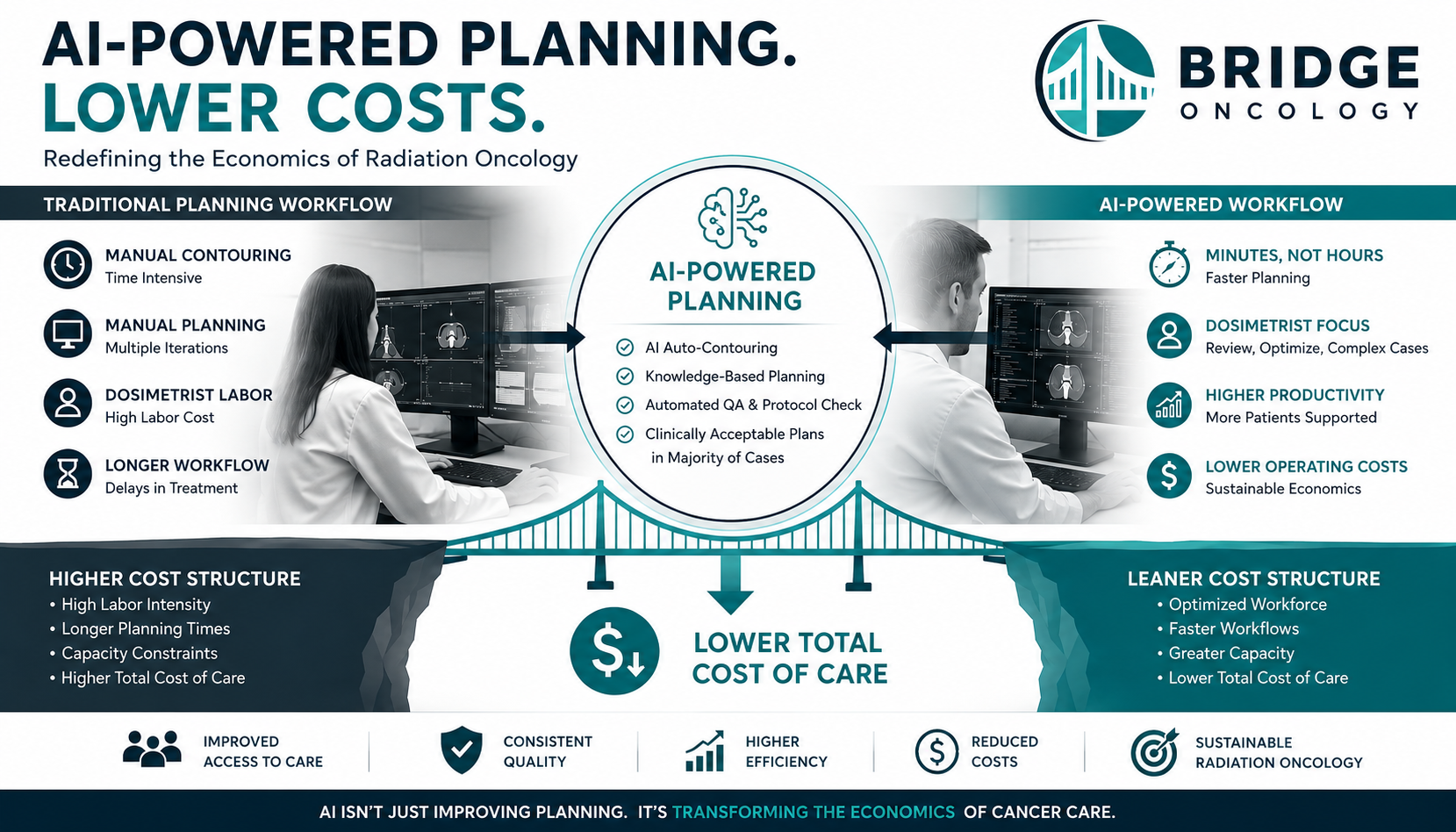
AI Is About to Redefine the Economics of Radiation Oncology
The next major advancement in radiation oncology won’t simply improve treatment planning—it will fundamentally change the cost structure of cancer care.
For years, conversations surrounding artificial intelligence (AI) in radiation oncology have focused on improving contour accuracy, reducing planning time, and expanding access to care. Those are important benefits, but they are not the most significant implication.
The real story is economic.
A recently published study in the Journal of Clinical Oncology: Global Oncology demonstrated that an AI-powered Radiation Planning Assistant (RPA) successfully generated clinically acceptable treatment plans for both prostate and cervical cancer with minimal human intervention. While the authors designed the system to improve access to radiation therapy in low- and middle-income countries, the findings have much broader implications for health systems across the United States.
The study suggests that AI is no longer simply assisting treatment planning. It is beginning to transform one of the largest operational cost centers in radiation oncology.
Treatment Planning Is One of Radiation Oncology’s Largest Labor Costs
Radiation oncology is among the most expensive service lines to operate within a hospital or health system. The majority of expenses are fixed, including linear accelerators, treatment vaults, physics support, service contracts, software licensing, and regulatory compliance. Industry estimates suggest that approximately 80% to 82% of operating expenses are fixed.
That leaves labor as one of the few remaining opportunities to improve financial performance.
Within the clinical workflow, medical dosimetry represents one of the most specialized and labor-intensive functions. Every patient requires contouring, treatment planning, optimization, physician review, quality assurance, and plan approval before treatment can begin. Even routine cases can consume hours of highly specialized professional time.
As reimbursement continues to tighten while labor costs continue to increase, treatment planning has become one of the largest controllable operational expenses in radiation oncology.
AI Is Changing the Question
The findings from the Radiation Planning Assistant study are impressive.
The AI platform automated image segmentation, contour generation, treatment planning, protocol verification, and quality assurance support. Approximately 70% of prostate contours required no physician edits, and nearly three-quarters of prostate treatment plans were clinically acceptable without modification. Similar performance was demonstrated for cervical cancer planning, with approximately 80% of plans meeting clinical standards after automated generation.
Those numbers are important, but they are not the most significant takeaway.
The real question is no longer:
Can AI create a clinically acceptable treatment plan?
Increasingly, the answer appears to be yes.
The question health system executives should now be asking is:
How many dosimetrists will be needed when AI performs the initial planning and clinicians transition to supervising and optimizing AI-generated plans rather than manually building every treatment plan from scratch?
That is a fundamentally different workforce model.
This Is Not About Replacing Dosimetrists
Every discussion about AI eventually turns toward workforce concerns. That conversation often misses the point.
The future is unlikely to eliminate the need for experienced dosimetrists. Instead, it will redefine how their expertise is used.
Rather than spending hours constructing routine treatment plans manually, dosimetrists will increasingly focus on reviewing AI-generated plans, managing complex anatomy, supporting adaptive radiation therapy, validating quality metrics, and overseeing AI governance throughout the treatment planning process.
Their value shifts from repetitive manual production to high-level clinical oversight.
That is a higher-value role for clinicians and a more efficient operating model for health systems.
The Operational Implications Are Significant
If AI consistently produces acceptable first-pass treatment plans, the economics of treatment planning begin to change dramatically.
Health systems can increasingly develop centralized enterprise planning teams that support multiple facilities from a single location. Remote planning becomes more scalable. Standardized planning protocols become easier to implement across large health systems. Individual dosimetrists can safely manage larger patient volumes because they are validating and optimizing plans instead of manually constructing every case.
The result is greater planning capacity without proportional increases in staffing.
For organizations struggling with workforce shortages, this becomes a powerful strategic advantage.
For organizations struggling with operating margins, it becomes a financial necessity.
AI Is Becoming a Cost Reduction Strategy
Healthcare has entered an era where improving quality alone is no longer enough.
Every technology investment must also improve operational efficiency and reduce the total cost of care.
Artificial intelligence is beginning to accomplish both simultaneously.
Better workflow efficiency means patients begin treatment sooner.
Standardized planning reduces variation.
Automation increases productivity.
Higher productivity reduces labor costs.
Lower labor costs improve financial sustainability.
This is precisely the direction Medicare, commercial payers, and value-based care models continue to encourage.
The Future of Radiation Oncology Will Be Built on Operational Excellence
Much of the industry’s attention remains focused on reimbursement policy, payment reform, and annual Medicare rulemaking.
Those issues certainly matter.
However, organizations that focus exclusively on reimbursement may miss the larger transformation occurring underneath them.
The next competitive advantage in radiation oncology will not come from collecting a few additional dollars per fraction.
It will come from fundamentally redesigning how care is delivered.
Artificial intelligence is rapidly becoming the infrastructure that allows health systems to produce higher-quality treatment plans with fewer resources, greater consistency, and improved operational performance.
The winners over the next decade will not necessarily be those with the newest technology or the largest market share.
They will be the organizations capable of delivering the same—or better—clinical outcomes at a meaningfully lower cost.
That is the true promise of AI.
It is not simply transforming treatment planning.
It is transforming the economics of radiation oncology.
Babier A, et al. Artificial Intelligence–Powered Radiation Treatment Planning for Cervical and Prostate Cancers in Low- and Middle-Income Countries. JCO Global Oncology. 2026. Available at: https://ascopubs.org/doi/10.1200/GO-25-00702