

Why Bridge Oncology Believes Transparency Is a Professional Responsibility
Why Bridge Oncology Believes Transparency Is a Professional Responsibility
Healthcare has reached a point where one of its greatest risks is no longer a lack of innovation, but a lack of honest evaluation. Every year, oncology professionals are introduced to new technologies, artificial intelligence platforms, consulting methodologies, reimbursement strategies, payment models, operational frameworks, and software solutions that promise to transform cancer care. Some genuinely move the profession forward. Others simply repackage old ideas with new branding, while some create little more than expensive distractions supported by persuasive marketing rather than measurable outcomes.
The challenge is not that innovation exists. The challenge is that too few people are willing to objectively evaluate whether these innovations actually deliver on their promises.
At Bridge Oncology, we believe transparency is not simply a business philosophy. It is a professional obligation.
That conviction is the reason we recently introduced our No Tacit Approval or Endorsement Disclaimer, which now appears before every presentation, educational session, and industry discussion we lead. The disclaimer represents far more than a legal safeguard. It reflects our belief that healthcare professionals have an ethical responsibility to distinguish evidence from marketing, operational reality from theory, and sustainable solutions from attractive narratives. We believe that mentioning a company, product, publication, professional society, software platform, artificial intelligence solution, consulting methodology, or payment model should never be interpreted as an endorsement simply because it was discussed. Likewise, when we believe something is unsupported by evidence, economically unsustainable, operationally ineffective, legally questionable, or inconsistent with the direction healthcare is moving, we believe we have a professional responsibility to discuss those concerns openly.
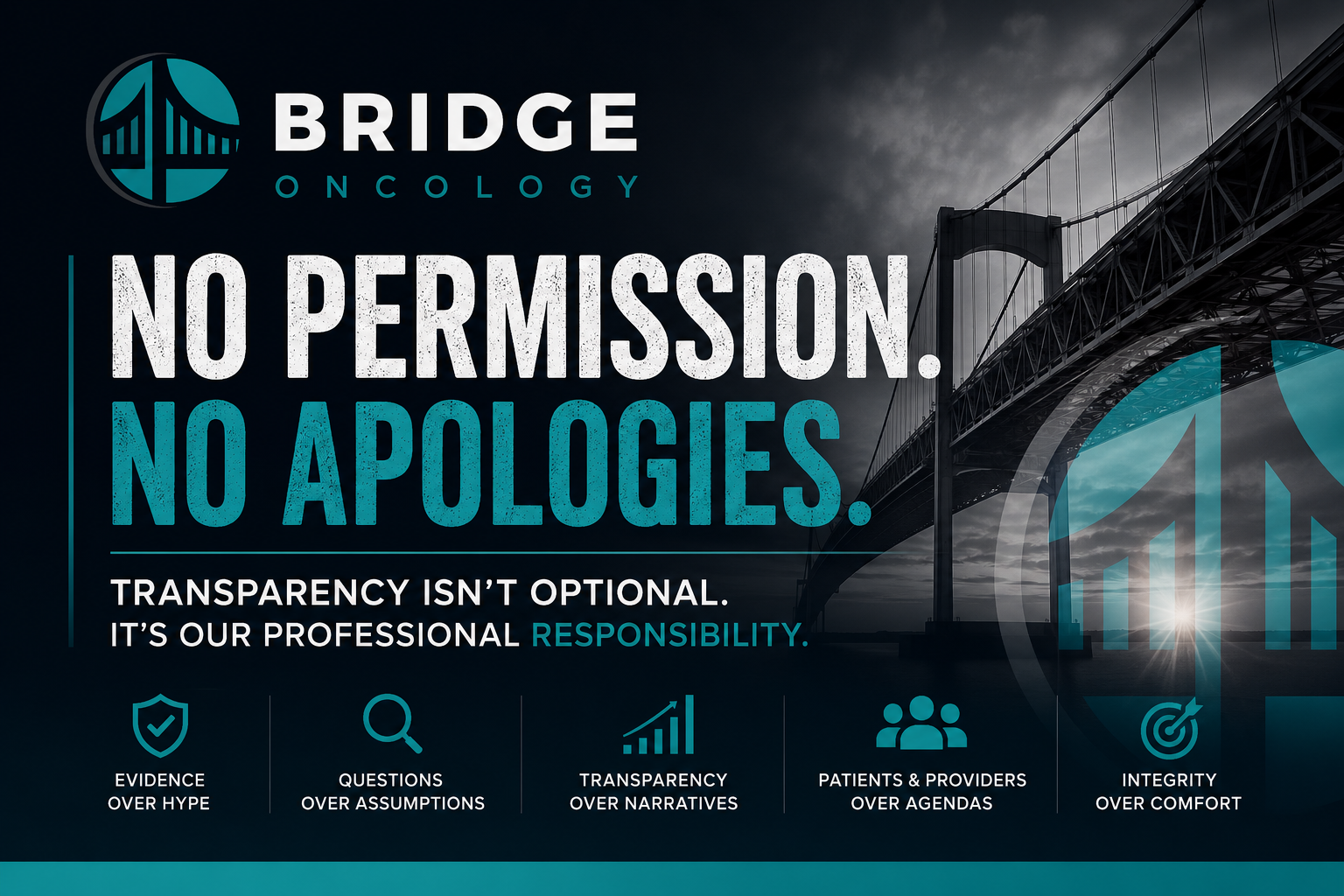
We do not believe that responsibility requires permission, and we certainly do not believe it deserves an apology.
One of the most dangerous forces in modern healthcare is tacit approval. Tacit approval rarely occurs because professionals intentionally endorse poor ideas. More often, it develops because experienced leaders choose not to challenge them. They remain silent to avoid conflict, preserve relationships, protect business opportunities, or simply because speaking honestly has become professionally uncomfortable. Over time, that silence creates the illusion of consensus. Marketing claims begin to sound like established facts. Vendor messaging becomes accepted wisdom. Repeated talking points become mistaken for evidence. Before long, an entire profession begins making strategic decisions based upon assumptions that were never independently validated.
Silence does not remain neutral forever. Eventually, it becomes participation.
At Bridge Oncology, we refuse to allow our silence to become someone else’s endorsement.
This is particularly important as radiation oncology and the broader healthcare industry navigate extraordinary economic and regulatory change. Artificial intelligence is rapidly entering clinical workflows. New reimbursement methodologies are emerging. Alternative payment models continue to evolve. Hospitals are facing unprecedented financial pressure, and vendors are racing to position their products as indispensable solutions. In an environment like this, professionals have an obligation to ask difficult questions before accepting extraordinary claims. Every technology should demonstrate measurable clinical or operational value. Every reimbursement strategy should align with regulatory direction rather than wishful thinking. Every consulting methodology should produce sustainable results rather than temporary optimism. Every software platform should solve a meaningful problem instead of simply creating another recurring expense.
Healthcare deserves objective evaluation, not promotional storytelling.
Unfortunately, the loudest voices are not always the most accurate voices. Large marketing budgets, conference sponsorships, polished presentations, and carefully crafted white papers often create an appearance of authority that exceeds the strength of the underlying evidence. Ideas can become popular long before they become proven. Popularity, however, has never been a substitute for evidence, and visibility has never been synonymous with value.
Medicine has never advanced by accepting claims simply because they were repeated often enough.
It has advanced because professionals were willing to examine assumptions, challenge prevailing opinions, and demand evidence before changing practice.
That is precisely the role Bridge Oncology intends to continue serving.
Some organizations exist primarily to market products. Others exist to protect institutional interests. Others advocate for specific reimbursement models or business strategies. There is nothing inherently wrong with those roles, provided everyone understands the perspective from which they are speaking. Our responsibility is different. Bridge Oncology exists to evaluate oncology operations, economics, reimbursement, technology, compliance, and strategy through the lens of independent analysis. Our obligation is to patients, providers, healthcare organizations, and the long-term sustainability of cancer care—not to preserving industry narratives or protecting comfortable consensus.
That commitment occasionally requires conversations that are uncomfortable.
It sometimes means explaining why a widely promoted reimbursement strategy does not align with where CMS is clearly signaling the healthcare system is headed. It sometimes means demonstrating that an expensive artificial intelligence platform creates administrative work without producing measurable clinical or financial improvements. It sometimes means questioning consulting recommendations that were effective several years ago but no longer reflect today’s operational realities. It may also require identifying when marketing claims extend well beyond the available evidence or when an industry narrative has become disconnected from economic reality.
Those discussions should never be mistaken for personal attacks.
Questioning an idea is not attacking the people behind it.
Evaluating a software platform is not criticizing the engineers who developed it.
Disagreeing with a professional society’s position is not dismissing the countless contributions that organization has made to the specialty.
Healthy professions become stronger when ideas are examined honestly rather than protected from criticism. Every meaningful advancement in medicine has required someone willing to ask difficult questions that others preferred to avoid. Professional respect should never require intellectual surrender, and collaboration should never require silent agreement.
At Bridge Oncology, we also recognize that transparency demands humility. Independent analysis is only valuable if it remains genuinely independent. We do not believe we possess every answer, nor do we believe our opinions are beyond challenge. If stronger evidence emerges, we will change our position. If another organization develops a better solution, we will acknowledge it. If our analysis is proven incorrect, we will say so publicly. Our commitment has never been to defending our own conclusions. Our commitment is to pursuing the truth wherever the evidence leads.
Ultimately, this philosophy is not about creating controversy, generating attention, or positioning ourselves against others in the industry. It is about protecting the integrity of healthcare decision-making. Patients deserve care built upon evidence rather than marketing. Providers deserve guidance grounded in operational reality rather than sales narratives. Healthcare organizations deserve strategies capable of surviving economic scrutiny rather than simply producing impressive presentations.
The future of radiation oncology will not be secured through carefully managed messaging, unquestioned assumptions, or institutional comfort. It will be secured through intellectual honesty, evidence-based leadership, transparent discussion, and professionals who are willing to distinguish between what is real, what is illusion, and what is simply another agenda.
That is the standard we have chosen for Bridge Oncology.
We will continue to recognize innovation when it genuinely advances patient care, improves operational performance, strengthens financial sustainability, and moves oncology forward. We will also continue to challenge ideas that fail to withstand objective scrutiny, regardless of how popular they become or who is promoting them. We believe that remaining silent in the face of misinformation, unsupported claims, or unsustainable business practices does not preserve professionalism—it weakens it.
Our responsibility is not to make everyone comfortable.
Our responsibility is to keep the profession honest.
That responsibility requires neither permission nor apology.