

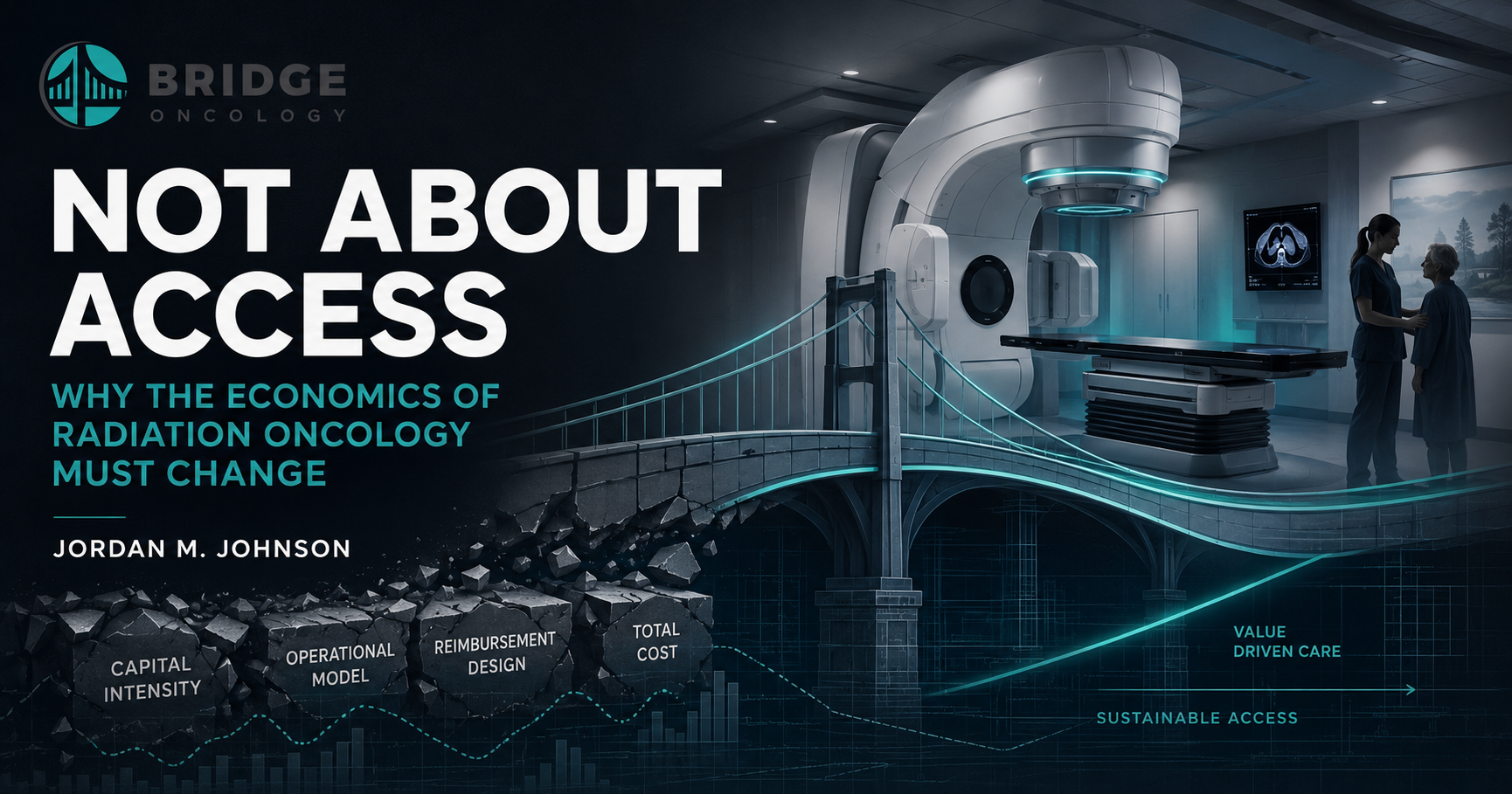
Bridge Oncology is proud to announce the release of Not About Access: The Economics of Radiation Oncology, the first book in Jordan Johnson’s Oncology Finance Trilogy.
The book was written to challenge one of the most persistent assumptions in radiation oncology: that the central problem facing the specialty is access.
Access absolutely matters. Patients should be able to receive timely, high-quality cancer treatment as close to home as possible. But the loss of access is often the final visible consequence of something that began years earlier.
The deeper problem is economic sustainability.
That distinction is the foundation of Not About Access.
Radiation oncology centers do not disappear because patients suddenly stop needing cancer care. They disappear after years of margin compression, delayed capital investment, workforce challenges, aging infrastructure, rising administrative costs, payer pressure, and increasing technology expense eventually make the underlying delivery model unsustainable.
The book asks healthcare leaders to stop measuring only the outcome and begin examining the forces that created it.
Geography Is Only Part of the Story
Much of the national conversation surrounding radiation oncology access has focused on maps showing communities or counties without treatment facilities. Those maps are important, but they do not tell the complete story.
Healthcare markets are not defined by county lines.
Patients cross county boundaries every day based on physician referrals, hospital affiliations, transportation patterns, insurance networks, and personal preference. A patient may technically live in a county without a radiation oncology center while remaining twenty minutes from treatment. Another patient may live in a county with a treatment center but still face substantial access barriers because of limited staffing, capacity constraints, equipment downtime, or long travel distances within that county.
As Not About Access explains, geography determines where care could be delivered. Economics determines whether that care can continue to be delivered.
That difference matters because the way a problem is defined ultimately determines the solutions that follow.
If policymakers define the problem exclusively as geography, the natural response is to build more facilities, provide temporary subsidies, create demonstration projects, or increase reimbursement.
Those interventions may help. They do not necessarily change the economics that caused previous infrastructure to become unstable.
Radiation Oncology Is a Capital Business
Radiation oncology is one of the most capital-intensive areas of modern medicine.
A program requires far more than a physician and a treatment machine. Organizations must support linear accelerators, vault construction, treatment planning systems, imaging platforms, software, cybersecurity, medical physics, dosimetry, therapists, nursing, quality assurance, compliance programs, revenue cycle operations, and highly specialized maintenance and service agreements.
Those costs do not disappear when patient volumes decline.
A linear accelerator costs essentially the same to maintain whether it treats fifteen patients per day or forty. Physics coverage remains necessary. Therapists remain necessary. Quality and safety requirements remain necessary. Software subscriptions and service agreements continue regardless of throughput.
At the same time, clinical practice has become more efficient.
Hypofractionation has reduced the number of treatments required for many patients. Treatment planning has improved. Image guidance has become more sophisticated. Automation and artificial intelligence are beginning to reduce portions of manual clinical work.
These changes are good for patients and good for medicine.
However, the economic model has not evolved at the same pace.
Revenue per patient may decline as treatment courses become shorter, while the fixed infrastructure required to safely deliver care remains largely intact. That creates an increasingly difficult economic equation for community-based programs.
The Hidden Cost of Delivering Care
One of the most important themes in Not About Access is that reimbursement is only one side of the sustainability equation.
The other side is cost.
Radiation oncology organizations are absorbing increasing expenses associated with software licensing, cybersecurity, workforce shortages, regulatory compliance, prior authorization, payer denials, documentation requirements, revenue cycle complexity, and technology.
Administrative complexity alone has become a significant cost center.
Prior authorization now requires dedicated staff, tracking systems, payer communication, clinical documentation review, appeals, and physician involvement. Revenue cycle teams must manage rapidly changing coding requirements, medical necessity policies, payer edits, and reimbursement rules. Compliance expectations continue to grow.
None of these activities directly deliver radiation therapy.
All of them must be paid for.
This is why the long-term sustainability of radiation oncology cannot be solved through reimbursement alone.
Payment matters, and appropriate reimbursement is essential. But increasing reimbursement without addressing the underlying cost structure only provides temporary relief if the cost of operating the delivery system continues to rise.
The book states the challenge clearly: the more important question is not simply what organizations are paid, but what it costs them to deliver care.
Access Follows Investment
Healthcare infrastructure follows capital.
Operating margin allows organizations to replace equipment, recruit physicians, modernize technology, expand programs, improve workflows, and prepare for future growth. When margins weaken, capital investment slows.
Equipment replacement is delayed. Vacant positions remain open longer. Technology modernization is postponed. Recruitment becomes more difficult. Competitiveness declines. Referral patterns begin to change.
Eventually, financial weakness becomes an access problem.
The closure is not the beginning of the story.
It is the end.
This is why Not About Access argues that sustainable access follows sustainable economics. Communities preserve cancer-care infrastructure when organizations have the financial confidence to continue investing in people, technology, facilities, and innovation.
A Different Conversation for the Future of Oncology
The purpose of this book is not to diminish the importance of access, reimbursement, workforce, policy, or technology.
It is to connect them.
Radiation oncology is operating inside a broader healthcare ecosystem. Population density influences demand. Payer mix influences reimbursement. Reimbursement affects operating margin. Margin creates capital. Capital supports reinvestment. Reinvestment influences workforce, technology, capacity, competitiveness, and ultimately patient access.
Those variables cannot be addressed independently.
The future of community oncology will require payment policy that reflects market reality, technology that reduces rather than simply adds cost, more efficient workforce models, less administrative complexity, stronger regional collaboration, and a much greater focus on total cost of care.
The goal should not be to continually rescue programs after they become financially distressed.
The goal should be to create healthcare systems in which rescue becomes the exception rather than the expectation.
That is why Not About Access begins the Oncology Finance Trilogy.
Before healthcare can redesign payment, accountability, operations, or technology, it first has to understand the economic foundation supporting care.
The conclusion of Book One is simple:
If we build sustainable economics, we will preserve sustainable access.
And preserving that access for the next generation of patients is ultimately the reason this conversation matters.