


Policy Analysis
Abstract
Rural radiation oncology programs must sustain capital-intensive technology, specialized personnel, and regulatory infrastructure despite patient volumes that are often insufficient to produce urban-scale economies. At the same time, repeated in-person treatment makes geographic proximity integral to access, adherence, and continuity of care. This policy analysis proposes a hybrid Centers for Medicare C Medicaid Services payment framework that separates episode-level reimbursement from the cost of preserving essential local capacity. The framework combines a base episode payment, a targeted Rural Access Payment Adjustment, a Technology Sustainability Payment, a distinct Ǫuality Incentive Payment, and support for telehealth and regional hub-and-spoke capabilities. Eligibility would be determined through an Essentiality Test using geospatial access, travel burden, local demand, alternative capacity, workforce availability, utilization, quality, and validated cost data. The model is intended to protect necessary access without subsidizing avoidable inefficiency. A geographically diverse CMS demonstration, supported by claims analysis, facility-level cost data, actuarial modeling, and periodic reassessment, is recommended before broader implementation.
Key Points
Ǫuestion: How can Medicare preserve necessary rural radiation treatment capacity without creating an unconditional subsidy for low-volume facilities?
Proposed approach: Separate payment for the clinical episode from targeted support for validated essential capacity, technology sustainability, and regional integration.
Policy implication: Rurality and low volume should trigger an individualized essentiality assessment; continued support should depend on access need, quality, utilization, and current resource requirements.
1. Introduction
Access to radiation oncology services for rural populations is an important challenge in modern cancer care. As Medicare reimbursement evolves toward value-based and episode-based payment, rural radiation oncology centers may face disproportionate financial pressure because they must maintain specialized infrastructure, technology, regulatory compliance, and clinical workforce capacity despite lower patient volumes than many urban programs. Patients, meanwhile, often depend on repeated local visits for treatment, making geographic proximity an important component of access, adherence, and continuity of care.
Approximately one-half of all patients diagnosed with cancer will require radiation therapy during the course of their disease. Because radiation treatment must be delivered in person over multiple visits, local availability directly influences treatment initiation, completion, and continuity of care. Recent national research found that more than 50 million Americans live in counties without a radiation oncology practice site and that practice-site disappearance from 2018 to 2025 disproportionately affected rural and freestanding community settings. Closure of rural radiation oncology centers can therefore increase travel burden and threaten timely access, particularly among elderly and medically vulnerable populations. [15,19,20,21]
The economic challenge is equally important. Rural centers must maintain essential fixed infrastructure and specialized staffing across a patient volume that may be too small to generate the economies of scale available in larger markets. The resulting higher fixed cost per treatment is not necessarily evidence of inefficiency; it may reflect the cost of preserving local capacity.
Medicare payment for radiation oncology is shaped by multiple payment systems, including the Medicare Physician Fee Schedule (PFS) and the Hospital Outpatient Prospective Payment System (OPPS), depending on the setting in which care is furnished. CMS has also pursued alternative payment approaches intended to move radiation oncology away from volume-based fee-for-service reimbursement toward prospective, episode-based payment linked to quality. The Radiation Oncology (RO) Model was designed around prospective, site-neutral, modality-agnostic episode payments, with professional and technical components and quality-related payment adjustments. CMS has delayed implementation of the RO Model, and its current start date remains to be determined through future rulemaking. [2,3]
The CY 2026 Medicare Physician Fee Schedule environment further demonstrates why national payment changes should be evaluated in the context of rural practice characteristics. CMS finalized separate conversion factors for qualifying Alternative Payment Model participants and other clinicians, with a final nonqualifying conversion factor of $33.40 and a qualifying APM conversion factor of $33.57. CMS also finalized an efficiency adjustment affecting the work relative value units of certain services. For CY 2027, CMS proposed conversion factors of $32.84 for non-qualifying APM participants and $33.17 for qualifying APM participants and noted that the one-year statutory 2.50% PFS increase enacted for CY 2026 would not continue in CY 2027. Radiation oncology also experienced substantial coding and payment changes beginning in CY 2026, with early national survey data from ASTRO reporting significant financial effects, particularly among freestanding and community-based practices. [4,5,18]
CMS has separately recognized that rural communities require a geographic and operational lens in payment and delivery-system policy. CMS rural health initiatives emphasize access, provider support, telehealth, workforce, technology, and sustainable delivery models. The Rural Health Transformation Program was authorized at $50 billion over five years, with $10 billion available in each fiscal year from 2026 through 2030, to support state-led efforts to improve rural access, quality, workforce capacity, technology, and innovative care models. These initiatives provide an important foundation for rural health transformation but do not substitute for a radiation-oncology-specific payment mechanism that recognizes the fixed infrastructure and specialized workforce required to maintain local treatment capacity. [1,6]
Medicare also has precedent for recognizing the financial realities of low-volume rural healthcare. Critical Access Hospitals operate under a distinct Medicare payment method, and the Rural Community Hospital Demonstration tests cost-based reimbursement for selected small rural hospitals that do not qualify as Critical Access Hospitals. These programs demonstrate that Medicare policy can use targeted payment approaches when conventional methodologies threaten the viability of essential rural services. [7,8]
The central policy issue is not whether rural radiation oncology should receive a categorical rural subsidy. Rather, CMS should determine whether a community requires local radiation treatment capacity, what resources are necessary to maintain that capacity, and what payment structure will sustain safe, efficient, high-quality care. This distinction moves the discussion from a categorical rural payment increase toward a data-driven model that supports essential access while maintaining accountability for quality, utilization, efficiency, and outcomes.
The proposed policy is organized around three complementary payment functions: (1) pay for the episode—the Base Episode Payment supports the actual radiation oncology treatment; (2) pay for essential capacity—the Rural Access Payment Adjustment and Technology Sustainability Payment address legitimate costs that cannot be recovered through low patient volume alone; and (3) pay for performance and integration—quality, outcomes, telehealth, and regional networks ensure that additional support remains accountable rather than becoming an unconditional subsidy.
Together, these elements create a payment architecture in which access, economic sustainability, quality, and integration are addressed within a single framework.
2. Why Rural Radiation Oncology Requires a Different Payment Model
Radiation oncology differs from many healthcare services because treatment delivery cannot be completed remotely. Patients often receive therapy over multiple visits, making proximity to treatment an important determinant of access and adherence. Rural centers may also face higher per-patient operating costs, persistent shortages of radiation oncologists, medical physicists, dosimetrists, and radiation therapists, and substantial patient travel burdens. National analyses demonstrate that geographic access to radiation therapy is uneven, with greater distance associated with nonurban residence and other socioeconomic vulnerabilities. [9,10,11,12,20,21]
When a rural center closes, transportation, lodging, caregiver, and time costs may shift from the provider to patients and families. Travel burden has been associated with treatment-related disparities and, in some settings, poorer outcomes. A payment methodology designed primarily for high-volume urban practices may therefore fail to capture the economic consequences of maintaining treatment capability in geographically underserved areas. [9,10,11,19,20,21]
Workforce availability is part of this access problem. Rural programs may face persistent shortages of radiation oncologists, medical physicists, dosimetrists, and radiation therapists. A sustainable model must therefore consider whether the workforce needed to maintain local treatment capacity is available and whether specialized functions can be supported through regional collaboration. [1,12,22]
3. The Rural Fixed-Cost and Low-Volume Problem
The fundamental economic challenge is the relationship between fixed infrastructure and low patient volume. A rural radiation oncology facility may treat eight patients or thirty patients per day while still requiring the same essential fixed infrastructure and specialized staffing. These requirements do not decline in direct proportion to treatment volume. When volume is low, fewer treatment episodes are available over which to distribute these fixed costs, increasing the effective cost of maintaining local capacity.
This distinction is especially important in an era of evidence-based treatment approaches. Fewer treatment fractions can reduce patient visits and selected variable episode costs, but they do not eliminate the infrastructure required to maintain local radiation treatment capability. Hypofractionation therefore should not be interpreted as evidence that the underlying cost of preserving local treatment capacity falls proportionally. The payment model must distinguish the cost of delivering an individual episode from the cost of keeping the capability available.
A sustainable payment policy should distinguish between efficiency and capacity preservation. CMS should continue to reward appropriate resource utilization and evidence-based treatment, but the payment methodology should also recognize the legitimate cost of maintaining essential local capacity in communities where patient volume cannot support the same economies of scale available in urban markets. This is the economic rationale for a Rural Access Payment Adjustment and a Technology Sustainability Payment within the proposed hybrid framework. Recent 2026 evidence of financial strain among radiation oncology practices and emerging evidence of radiation oncology site disappearance further support the need to examine whether current payment structures adequately protect essential access. These mechanisms should not insulate rural centers from accountability; they should allow CMS to preserve access while continuing to measure quality, outcomes, utilization, and patient experience. [2,3,7,8,18,19]
The policy implication is that rural sustainability should not be judged solely by whether a facility can deliver each treatment at a nationally competitive unit cost. The more relevant question is whether the payment system provides sufficient revenue to preserve the capacity to deliver safe, high-quality radiation therapy locally. Once a rural center closes, patients may have to travel farther for treatment, shifting transportation, lodging, caregiver, and time costs from the provider to patients, families, and other parts of the healthcare system. Evidence indicates that travel burden is an important barrier to radiation oncology access and is associated with treatment-related disparities and, in some settings, poorer outcomes. [9,10,11,19,20,21]
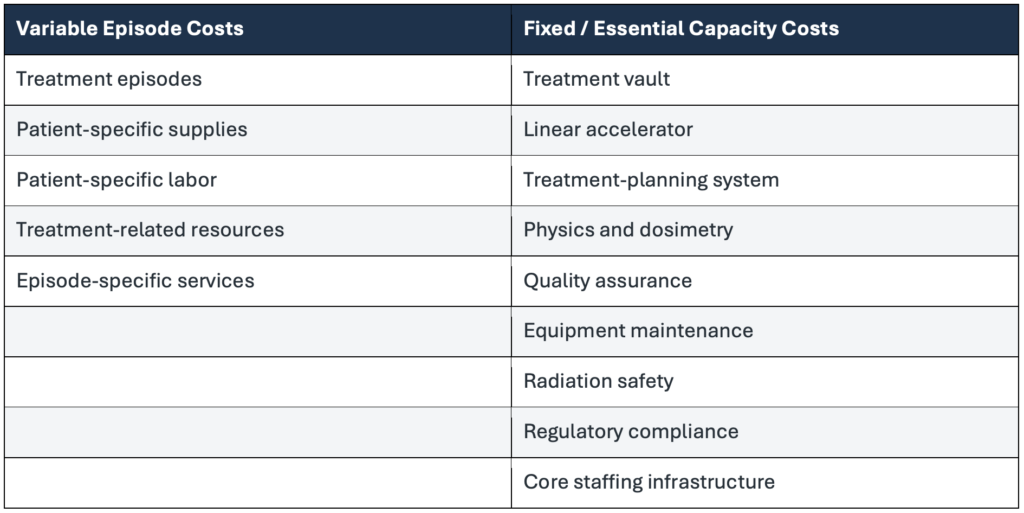
For payment design, these costs should be separated into variable episode costs and fixed or essential capacity costs. Variable costs are incurred as patient treatments are delivered; fixed or essential capacity costs are incurred to keep the program available whether the facility is treating a small or larger number of patients.
4. Principles of a Sustainable Rural Payment Model
An effective payment model should pursue four complementary objectives: preserve necessary access to radiation therapy, reward high-quality evidence-based care, recognize legitimate fixed and variable resource requirements, and create incentives for efficient operation. Rurality and low volume should identify circumstances for further evaluation, not automatically determine payment. The model should distinguish cost from price, essential capacity from avoidable excess capacity, and access preservation from facility preservation.
The proposed methodology begins with the clinical pathway and the resources required to deliver it safely. It then separates episode-level resource use from fixed infrastructure, evaluates whether local treatment capacity is essential to geographic access, and incorporates quality, outcomes, and appropriate utilization before determining sustainable payment.
5. Data-Driven Methodology for Determining Payment
Radiation oncology is particularly suited to a resource-based methodology because treatment is highly protocol-driven. For a defined diagnosis and clinical presentation, the major components of care can be identified, including consultation, simulation, treatment planning, dosimetry, physics, treatment delivery, image guidance, treatment management, and follow-up. The clinical pathway should therefore become the starting point for determining resource requirements rather than constructing the economic model from individual procedure codes upward.
Organizing sequence: Clinical pathway → required resources → costs → essentiality → geographic access →qualityandoutcomes→sustainablepayment.
Clinical pathway — Define the evidence-based episode and clinical services required.
Required resources — Identify labor, expertise, equipment, technology, and supporting services. Labor + time + technology — Measure resource use associated with the pathway.
Fixed infrastructure + variable costs — Separate episode-level costs from costs of maintaining capacity.
Essential capacity assessment — Determine whether local treatment capacity is necessary.
Geographic access / travel burden — Measure isolation, alternatives, travel time, and access consequences. Ǫuality + outcomes + appropriate utilization — Evaluate safety, outcomes, completion, experience, and efficiency. Validated sustainable cost — Determine the validated resource requirement for essential capacity.
CMS payment — Apply the hybrid payment architecture.
In shorthand: clinical pathway → required resources → labor and time → technology utilization → fixed infrastructure → variable expense → essential capacity → geographic access requirements → quality and outcomes → sustainable payment.
The resulting adjustment should vary among facilities. The purpose is not to establish a universal rural percentage, but to identify the payment required to sustain necessary local treatment capacity after accounting for actual costs, access conditions, and operational requirements.
Once the clinical pathway is established, CMS should determine the resources necessary to deliver it safely and efficiently. These should include direct clinical labor, physician time, physics, dosimetry, therapy, nursing, administrative support, treatment planning, quality assurance, information technology, equipment maintenance, facility expense, regulatory requirements, and other legitimate costs associated with maintaining an operational radiation oncology program.
These costs should not simply be inferred from historical reimbursement or generalized national assumptions. They should be measured using validated operational and financial data. What a provider historically received for a service does not necessarily establish what the service costs to deliver, and a vendor charge for technology does not automatically establish its economic value within Medicare reimbursement. A modern rural payment methodology should therefore be grounded in validated resource consumption and reasonable operating requirements.
6. The Essentiality Test: Supporting Necessary Capacity, Not Inefficiency
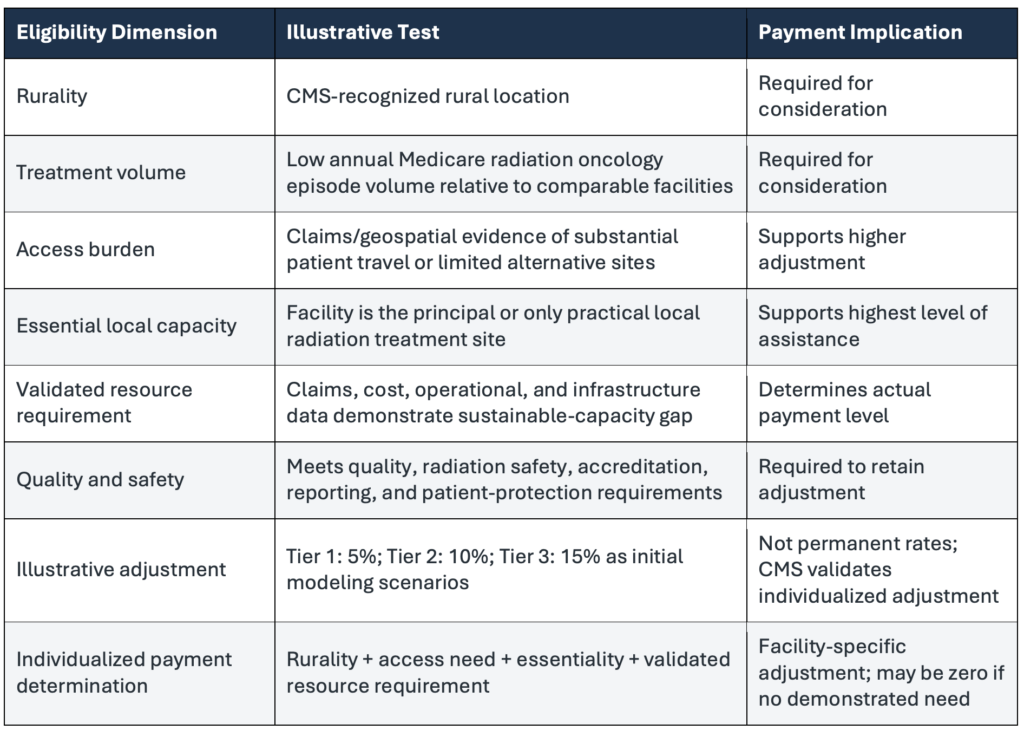
Rurality and low volume should trigger evaluation, not automatic payment. The Essentiality Test asks whether local radiation treatment capacity is necessary to preserve reasonable geographic access.
Necessary excess capacity reflects the resources required to maintain access when patients lack a reasonable alternative. Avoidable excess capacity may reflect operational problems such as poor scheduling, referral leakage, inefficient staffing, or unnecessary duplication and should not be permanently subsidized.
Eligibility should therefore rest on demonstrated access need, essentiality of local capacity, and validated resources required to maintain that capacity.
Potential CMS measures include:
- Geographic isolation and population density.
- Cancer incidence and expected radiation oncology demand.
- Travel time or travel burden to alternative radiation treatment facilities.
- Availability and capacity of competing treatment centers and existing regional treatment capacity.
- Equipment utilization and operational capacity.
- Referral patterns and evidence of local demand.
- Workforce availability and feasibility of maintaining essential staffing.
- Consequences of facility closure for treatment initiation, completion, continuity, and patient burden.
Integrating these variables into a quantitative sustainability model would allow CMS to support necessary access without creating an entitlement for every low-volume rural facility. Payment should follow demonstrated access need and validated resource requirements rather than rural classification alone.
The 5%, 10%, and 15% levels are illustrative modeling scenarios rather than empirically established payment rates.
7. The Hybrid CMS Payment Framework
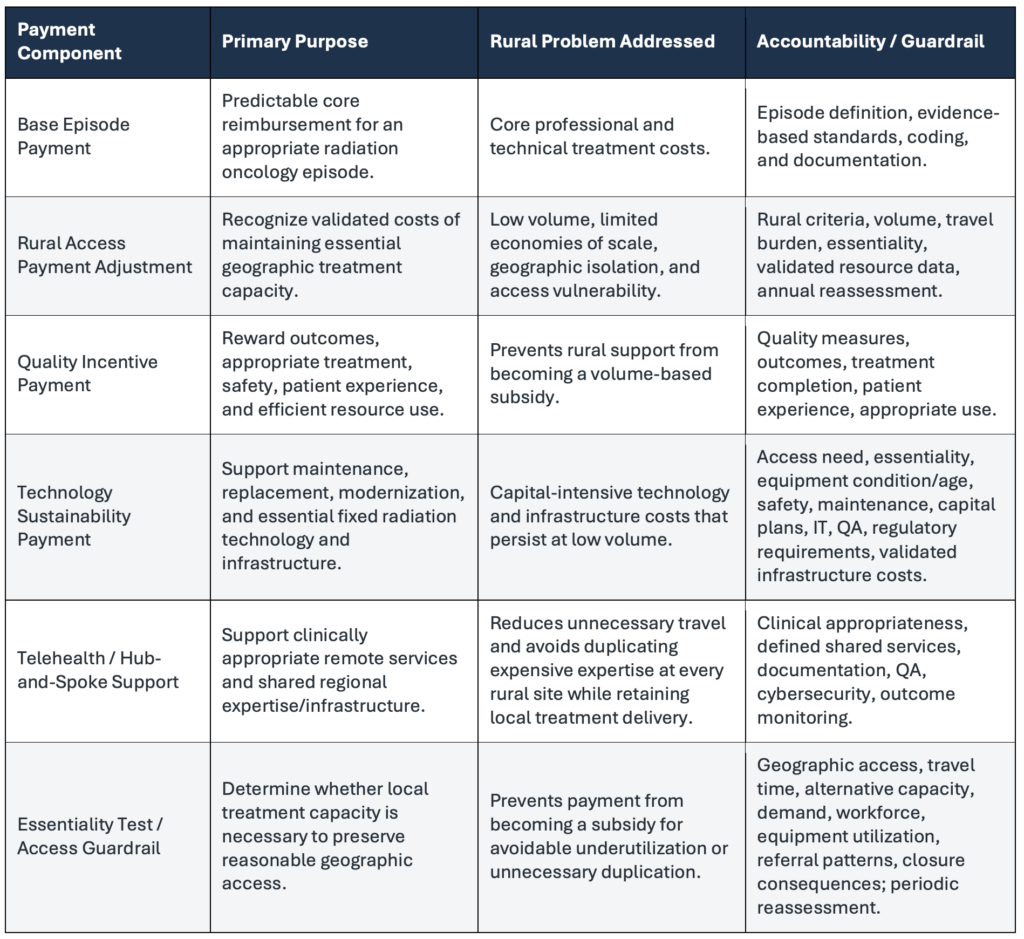
The Hybrid CMS Payment Framework is the policy expression of the data-driven methodology. It combines episode-based reimbursement with targeted support for essential geographic capacity, fixed infrastructure, quality, and shared network capabilities. Its sequence is: clinical pathway → required resources → labor, time, and technology → fixed infrastructure and variable costs → essential capacity assessment → geographic access and travel burden → quality, outcomes, and appropriate utilization → validated sustainable cost → CMS payment.
The Rural Access Payment Adjustment should be a targeted, prospective add-on to the Medicare radiation oncology episode payment. Eligibility and payment should be based on demonstrated access need, essentiality of local treatment capacity, and validated resource requirements, with rurality and low volume serving as screening characteristics rather than automatic entitlement.
The Rural Access Payment Adjustment should remain separate from the Ǫuality Incentive Payment. The access adjustment recognizes the cost of maintaining essential capacity; the quality component evaluates how well that capacity is used. Rural status should not lower the quality standard expected of a radiation oncology program.
8. Strengthening the Technology Sustainability Payment
These essential fixed infrastructure requirements remain necessary to maintain safe local treatment capacity even when patient volume is low.
The Technology Sustainability Payment should therefore support legitimate maintenance, replacement, modernization, quality assurance, information technology, radiation safety, and regulatory requirements when these costs are necessary to preserve essential local treatment capability. Eligibility should be linked to demonstrated
access need, essentiality, equipment condition and age, safety requirements, maintenance needs, capital replacement or modernization plans, and validated infrastructure costs.
Regional integration can support clinically appropriate sharing of specialized expertise and infrastructure while preserving local treatment access.
9. Regional Hub-and-Spoke Model
Treatment delivery must remain local because the patient must physically receive radiation. Supporting capabilities such as treatment planning, specialized physics expertise, peer review, subspecialty consultation, quality oversight, analytics, revenue-cycle expertise, prior authorization, compliance, and selected administrative functions can potentially be shared across participating facilities.
Tele-radiation oncology represents an important strategy for improving access while reducing unnecessary travel. CMS reimbursement should support clinically appropriate virtual consultations, treatment management, survivorship follow-up, multidisciplinary tumor board participation, peer review, and other services that can safely be delivered remotely. By limiting travel to occasions when treatment delivery or other in-person care is necessary, telehealth can enhance convenience without compromising quality.
The regional operating model should:
Centralize expertise. Localize treatment delivery. Standardize clinical pathways. Share appropriate infrastructure. Measure outcomes. Preserve access.
10. Workforce Sustainability Through Essentiality and Regional Integration
1. Geographic Value and Social Determinants of Health
Local radiation treatment capacity is therefore an important component of healthcare access and quality. The policy objective is not preservation of facilities for their own sake, but preservation of necessary treatment capacity where loss of local services would create a material access burden.
Preserving essential rural radiation oncology services should therefore be reflected in how CMS defines value. In rural settings, value must include not only financial efficiency but also timely treatment, completion, local availability, and reduced travel burden.
Payment policy should recognize the social and economic barriers faced by rural cancer patients. Transportation limitations, lower household incomes, reduced caregiver availability, and long travel distances can influence treatment adherence and outcomes. Incorporating these factors into reimbursement models could provide additional support where it is most needed and help reduce disparities in cancer care. [9,10,11]
Ǫuality should remain a separate accountability dimension within the payment model. Ǫuality measures should include evidence-based treatment, appropriate use of evidence-based hypofractionation, safety, treatment completion, patient experience, clinical outcomes, and efficient resource utilization. Access should also be measured through travel burden, timely treatment initiation, and preservation of local treatment availability. The Rural Access Payment Adjustment recognizes the cost of essential capacity; the Ǫuality Incentive Payment evaluates performance within that capacity.
2. Implementation and Limitations
The proposed framework should begin as a CMS demonstration rather than immediate nationwide adoption. CMS could select a geographically diverse group of rural radiation oncology facilities and use Medicare claims, facility cost data, operational data, geospatial travel measures, utilization data, quality measures, and patient outcomes to establish baseline requirements and test the individualized payment methodology. The demonstration should account for the current payment environment, including 2026 radiation oncology coding changes and CY 2027 PFS proposals, so that the model can distinguish structural access needs from temporary or broader payment effects. Results should be compared with relevant rural and urban/suburban comparators. [2,3,4,5,18,19,20]
The demonstration should also test whether clinical-pathway resource requirements can be measured consistently across sites, whether fixed and variable costs can be separated reliably, and whether claims and facility-level data are sufficient to identify the cost of maintaining essential treatment capacity. Actuarial modeling and sensitivity testing should evaluate how assumptions about volume, staffing, equipment, utilization, access burden, and capital requirements affect payment.
Periodic reassessment should be built into the model. CMS should review claims, validated cost and infrastructure data, treatment volume and utilization, geographic access, travel burden, quality, outcomes, workforce conditions, and the continuing essentiality of local treatment capacity. Payment should therefore follow current need rather than becoming a permanent subsidy.
Several limitations require attention. The appropriate payment level would require claims-based cost analysis, actuarial modeling, and sensitivity testing. Rurality is heterogeneous, and a single geographic definition may not capture differences in travel time, population density, workforce availability, competing treatment sites, or local cancer burden. Low volume may also result from changing referral patterns rather than structural access needs.
Recent payment changes and emerging evidence of practice-site disappearance indicate that the economic environment is changing rapidly; historical cost and utilization data may therefore not fully represent current sustainability pressures.
The model should include a phase-out mechanism. Continued eligibility should require minimum quality performance, compliance with radiation safety and accreditation requirements, submission of standardized cost and utilization data, and demonstration that local treatment capacity remains necessary. A facility that experiences sustained volume growth, develops reasonable access to competing treatment capacity, or demonstrates avoidable rather than necessary underutilization should be subject to reassessment.
Preserving a radiation oncology facility does not by itself guarantee optimal cancer outcomes. Payment policy must remain linked to evidence-based treatment, quality assurance, patient safety, treatment completion, and appropriate utilization. The framework should therefore complement—not replace—clinical quality standards and broader rural cancer policy. [13,14,19]
11. Conclusion
Rural radiation oncology faces a structural access problem: patients may depend on local treatment while centers must maintain specialized infrastructure and workforce capacity at volumes that may not support urban-scale economies. The resulting challenge is both clinical and economic.
The proposed solution is a hybrid, data-driven payment model that pays for the episode, supports essential capacity when demonstrated access and validated resource requirements warrant it, and links additional support to quality, outcomes, appropriate utilization, and regional integration.
This approach is not a categorical rural subsidy because payment follows demonstrated access need and validated resource requirements rather than rural classification alone. CMS should next test the model through a geographically diverse demonstration using claims, facility cost and operational data, geospatial access measures, quality outcomes, and actuarial modeling, with periodic reassessment to ensure that payment continues to reflect current need.
Corresponding Authors
R. Alan Burns, BSRT — ralanburns@msn.com
Jordan Johnson, MSHA, MLS — jordan@bridgeoncology.com
References
- Centers for Medicare C Medicaid Services. CMS Rural Health. Updated March 13, 2026. CMS.
- Centers for Medicare C Medicaid Services. Radiation Oncology Model. CMS Innovation Center. Updated 2026.
- Centers for Medicare C Medicaid Services. Radiation Oncology (RO) Model Fact Sheet. CMS. Updated September 18, 2020; current model status reviewed 2026.
- Centers for Medicare C Medicaid Services. Calendar Year (CY) 2026 Medicare Physician Fee Schedule Final Rule (CMS-1832-F). October 31, 2025.
- Centers for Medicare C Medicaid Services. Calendar Year (CY) 2027 Medicare Physician Fee Schedule Proposed Rule (CMS-1848-P). July 16, 2026.
- Centers for Medicare C Medicaid Services. Rural Health Transformation (RHT) Program. Updated July 8, 2026.
- Centers for Medicare C Medicaid Services. Critical Access Hospitals. CMS. Updated 2026.
- Centers for Medicare C Medicaid Services. Rural Community Hospital Demonstration. CMS Innovation Center. Updated 2025.
- Longacre CF, Neprash HT, Shippee ND, Tuttle TM, Virnig BA. Evaluating travel distance to radiation facilities among rural and urban breast cancer patients in the Medicare population. J Rural Health. 2020;36(3):334-346. doi:10.1111/jrh.12413.
- Silverwood SM, Waeldner K, Demeulenaere SK, et al. The relationship between travel distance for treatment and outcomes in patients undergoing radiation therapy: a systematic review. Adv Radiat Oncol. 2024;9(12):101652. doi:10.1016/j.adro.2024.101652.
- Koshy M, et al. Sociodemographic and clinical factors associated with radiation treatment, nonadherence, and survival among rural and nonrural patients with cancer. Int J Radiat Oncol Biol Phys. 2022. PMID:35777674.
- Showalter TN, et al. The pervasive crisis of diminishing radiation therapy access for vulnerable populations in the United States—Part 4: Appalachian patients. Adv Radiat Oncol. 2018;3(4). doi:10.1016/j.adro.2018.08.001.
- American College of Radiology; American Society for Radiation Oncology. ACR-ARS Practice Parameter for Radiation Oncology. 2024.
- American Society for Radiation Oncology. ASTRO/ASCO/AUA Guideline on Hypofractionation for Localized Prostate Cancer. 2018.
- Delaney G, Jacob S, Featherstone C, Barton M. The role of radiotherapy in cancer treatment: estimating optimal utilization from a review of evidence-based clinical guidelines. Cancer. 2005;104(6):1129-1137. doi:10.1002/cncr.21324.
- Carlone M, Beckham W, Duzenli C, Kohli K, Tyldesley S. Linear accelerator maintenance cost analysis. J Appl Clin Med Phys. 2023;25(2):e14246. doi:10.1002/acm2.14246.
- Luh JY. Radiation Oncology Alternative Payment Model’s Impact on Small and Rural Practices. JCO Oncol Pract. 2021;17(12):765-769. doi:10.1200/OP.21.00286.
- American Society for Radiation Oncology. ASTRO Survey on 2026 Coding Changes: Executive Summary. April 2026.
- Yu C, Lu SG, Arons D, Rowley JP, Sindhu KK. Structural Vulnerability in the United States Radiation Oncology Delivery System: Predictors and Consequences of Practice Site Disappearance. Int J Radiat Oncol Biol Phys. Published online July 9, 2026. doi:10.1016/j.ijrobp.2026.06.3090.
- Maroongroge S, Wallington DG, Taylor PA, Zhu D, Guadagnolo BA, Smith BD, Yu JB, Ballas LK. Geographic Access to Radiation Therapy Facilities in the United States. Int J Radiat Oncol Biol Phys. 2022;112(3):600-610. doi:10.1016/j.ijrobp.2021.10.144.
- Laskar SG, Sinha S, Krishnatry R, Grau C, Mehta M, Agarwal JP. Access to Radiation Therapy: From Local to Global and Equality to Equity. JCO Glob Oncol. 2022;8:e2100358. doi:10.1200/GO.21.00358.
- Lu SG, Sindhu KK, Rowley JP. Changes in Employment and Practice Locations Among Radiation Oncologists: 2015-2023. Int J Radiat Oncol Biol Phys. 2025;122(5):1095-1101. doi:10.1016/j.ijrobp.2025.02.036.