
Executive Summary
Email for full edition – jordan@bridgeoncology.com
Why the Biggest Story in CMS’ Proposed Rule Isn’t Just Drug Pricing—It’s the Future Financial Model of Hospital Outpatient Care
When CMS released the CY 2027 Hospital Outpatient Prospective Payment System (OPPS) Proposed Rule, much of the industry’s immediate attention focused on one issue: the proposed overhaul of the 340B Drug Pricing Program. That reaction is understandable. The proposal would dramatically reduce reimbursement for 340B-acquired drugs, creating significant financial implications for many hospitals across the country.
But if the conversation begins and ends with 340B, healthcare leaders risk missing the far more important message.
The CY 2027 Proposed Rule represents a fundamental shift in how CMS appears to envision financing outpatient healthcare. Rather than simply adjusting reimbursement rates, the proposal signals an evolving philosophy that rewards operational efficiency, enterprise integration, technology adoption, and value creation over historical funding mechanisms. For hospital executives, oncology leaders, and health system boards, this is the story that deserves the greatest attention.
340B Has Become Much More Than a Drug Discount Program
Over the past two decades, the 340B Drug Pricing Program has evolved well beyond its original purpose of reducing pharmaceutical acquisition costs.
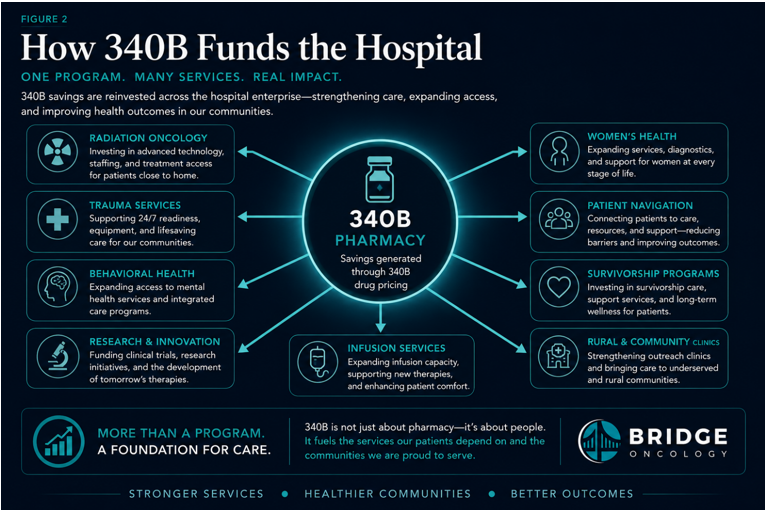
For many hospitals, particularly large health systems and safety-net providers, 340B has become a critical source of funding that supports programs extending far beyond pharmacy. Revenue generated through the program frequently subsidizes oncology services, specialty pharmacy, behavioral health, rural outreach initiatives, patient navigation, financial counseling, clinical research, and numerous other mission-driven services that often operate on thin margins.
The proposed reduction in reimbursement challenges one of the primary financial engines hospitals have relied upon to expand access, recruit specialized providers, invest in technology, and maintain comprehensive outpatient services.
Regardless of whether the proposal is finalized exactly as written, the direction is becoming increasingly clear: hospitals should prepare for an environment where supplemental reimbursement becomes less dependable and operational performance becomes increasingly important.
Radiation Oncology’s Projected Gains May Not Tell the Whole Story
One of the more surprising aspects of the Proposed Rule is that radiation oncology appears to receive substantial reimbursement increases across many treatment delivery codes.
At first glance, this looks like an unequivocal win.
However, these projected increases are largely the result of OPPS budget neutrality.
CMS is not introducing entirely new funding into the outpatient payment system. Instead, dollars removed from proposed 340B reimbursement reductions are redistributed across other outpatient services—including radiation oncology.
This distinction matters.
If CMS ultimately scales back the proposed 340B payment reductions in response to stakeholder feedback—as many industry observers anticipate—the redistribution pool could shrink as well. The corresponding increases currently projected for radiation oncology may also be reduced before the Final Rule is issued.
Healthcare organizations should therefore resist making significant staffing, capital investment, or strategic expansion decisions based solely on proposed reimbursement figures that remain subject to change.
Operational Excellence Is Becoming More Valuable Than Reimbursement Optimization
Perhaps the most important message embedded within the Proposed Rule is that reimbursement optimization alone will no longer be sufficient to ensure financial sustainability.
Hospitals today face simultaneous pressure from nearly every direction.
Workforce shortages continue to increase labor costs. Technology investments are accelerating as organizations implement artificial intelligence, advanced imaging, automation, and precision medicine. Prior authorization requirements continue to consume valuable clinical resources, while inflation places additional pressure on already narrow operating margins.
In this environment, financial success will increasingly depend on how efficiently organizations operate rather than simply how effectively they maximize reimbursement.
Integrated service lines, streamlined workflows, enterprise-wide analytics, coordinated revenue cycle operations, physician alignment, and disciplined operational governance are rapidly becoming competitive advantages.
Organizations that continue viewing reimbursement optimization as their primary financial strategy may find themselves increasingly disadvantaged compared to health systems investing in enterprise transformation.
Theranostics Illustrates the Challenge Ahead
Few service lines demonstrate this transition more clearly than theranostics.
Radiopharmaceutical therapy represents one of the fastest-growing areas in oncology, but successful program development requires substantial infrastructure investments. Hospitals must build capabilities in molecular imaging, radiopharmacy, radiation safety, specialized staffing, multidisciplinary coordination, and complex operational workflows before treating even a single patient.
These programs also carry significant financial exposure due to the high acquisition costs of radiopharmaceuticals and the extended time between drug purchase and payer reimbursement.
If enterprise margins become increasingly constrained, organizations may delay or reconsider these investments altogether.
The result could be an acceleration of strategic partnerships between hospitals and community oncology providers, creating new collaborative care models that reshape where advanced cancer therapies are delivered over the next decade.
The Real Strategic Opportunity
The CY 2027 OPPS Proposed Rule should not be viewed simply as a pharmacy issue or even an oncology issue.
It is an enterprise strategy issue.
Between now and publication of the Final Rule, healthcare leaders have an opportunity to prepare rather than react. Organizations should be modeling multiple reimbursement scenarios, evaluating operational performance across outpatient service lines, strengthening revenue cycle processes, improving financial forecasting, and integrating oncology, pharmacy, finance, technology, and clinical operations into a unified strategic framework.
Regardless of how CMS ultimately finalizes the Proposed Rule, one reality is becoming increasingly apparent: the future of outpatient healthcare will be defined less by isolated reimbursement opportunities and more by an organization’s ability to operate efficiently, innovate strategically, and deliver coordinated care across the entire enterprise.
Those that recognize this shift today will be positioned not only to withstand future payment reform—but to lead through it.