

When discussions arise about the challenges facing radiation oncology, the conversation almost always begins with reimbursement. Medicare cuts. Commercial payer pressure. Prior authorization. Declining patient volumes.
Those issues are real, but they are not the root cause of the crisis.
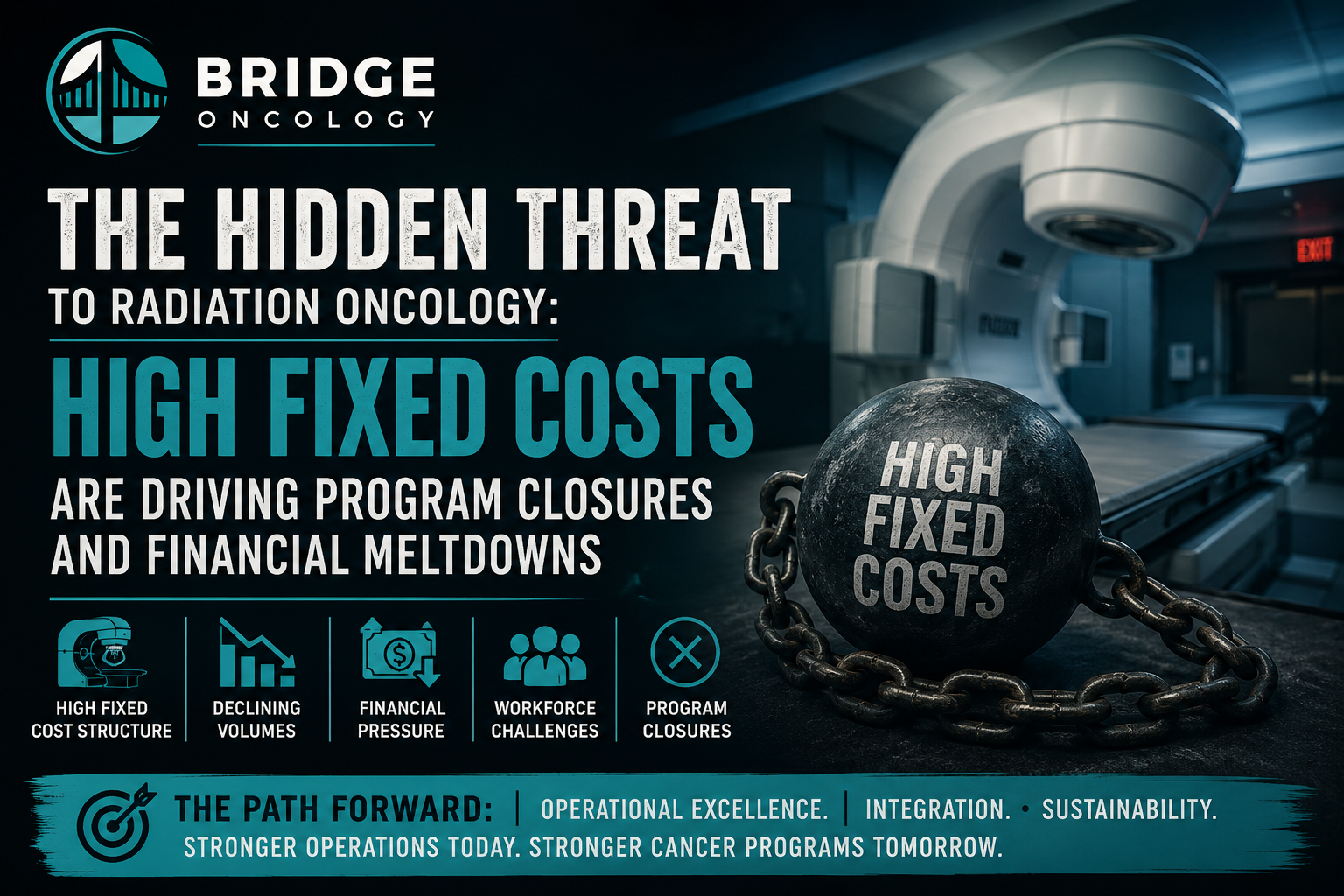
The single greatest financial challenge facing radiation oncology today is its extraordinarily high fixed-cost structure. Until healthcare leaders recognize this reality, reimbursement changes alone will never stabilize the specialty.
Across the country, hospital executives are asking the same question: Why are radiation oncology departments losing money despite remaining clinically busy? The answer often has less to do with patient volume than with the economics of operating one of healthcare’s most capital-intensive service lines.
Radiation Oncology Is Built on Fixed Costs
Unlike many outpatient specialties, radiation oncology cannot simply reduce expenses when patient volumes decline.
A linear accelerator costs millions of dollars to purchase and hundreds of thousands of dollars each year to maintain. Treatment planning systems, oncology information systems, CT simulators, quality assurance equipment, shielding, facility infrastructure, software licensing, and cybersecurity all represent fixed investments that exist whether twenty patients are treated each day or five.
The same is true for staffing.
Radiation oncologists, medical physicists, dosimetrists, radiation therapists, nurses, administrators, and support personnel must be available regardless of daily treatment volume. Regulatory requirements, accreditation standards, and quality assurance activities do not decrease simply because fewer patients arrive.
For most radiation oncology departments, between 78% and 82% of total operating expenses are fixed. That means only a relatively small portion of expenses changes as patient volume fluctuates.
Few healthcare service lines operate under this type of financial structure.
Small Volume Losses Create Large Financial Consequences
High fixed costs dramatically amplify even modest decreases in patient volume.
A five percent decline in treatment starts rarely translates into only a five percent reduction in profitability. Because the majority of operating expenses remain unchanged, that same decline often produces a much larger reduction in operating margin.
The financial leverage works in reverse as well.
When patient volumes grow, fixed costs are spread across more treatments, improving financial performance. When volumes fall, every remaining patient must absorb a larger share of those fixed expenses.
This creates an economic tipping point that many hospital executives underestimate.
Departments may appear financially stable for years before crossing a threshold where declining volume suddenly accelerates financial losses.
The Current Landscape Reflects This Economic Reality
The financial instability affecting radiation oncology today is not occurring because clinicians are providing lower-quality care.
It is occurring because the economics have fundamentally changed.
Hypofractionation has reduced the number of treatment fractions required for many disease sites. Advances in systemic therapies have altered referral patterns. Competition has increased in many markets. Prior authorization delays postpone treatment starts. Workforce shortages increase labor costs. Medicare reimbursement continues to experience downward pressure while inflation drives operating expenses higher.
None of these changes individually would necessarily threaten a radiation oncology department.
Together, however, they create an environment where high fixed costs become increasingly difficult to support.
This helps explain why hospitals across the country are consolidating cancer programs, delaying equipment replacement, reducing staffing, outsourcing services, or closing radiation oncology locations altogether.
These decisions are often viewed as reimbursement problems.
In reality, they are frequently fixed-cost problems.
Why Cost Cutting Alone Rarely Works
When financial pressure increases, organizations naturally look for expenses to reduce.
The challenge is that there are relatively few expenses available to cut.
A linear accelerator cannot be operated without physicists, therapists, physicians, and quality assurance processes. Equipment service contracts cannot simply disappear. Regulatory requirements remain unchanged regardless of patient volume.
Many organizations discover they can reduce only a small percentage of their operating expenses before clinical quality, patient safety, or regulatory compliance begin to suffer.
The mathematics of high fixed costs leaves very little flexibility.
The Operational Meltdown Happens Before the Financial One
Perhaps the greatest misconception is that financial collapse occurs suddenly.
It rarely does.
Operational deterioration almost always begins first.
Treatment planning queues gradually lengthen. Staffing vacancies remain open longer. Equipment maintenance is deferred. Capital replacement is postponed. Burnout increases. Patient access becomes more difficult. Recruitment becomes increasingly challenging. Revenue cycle problems grow. Referral relationships weaken.
Each issue appears manageable in isolation.
Collectively, they create a cycle that becomes increasingly difficult to reverse.
By the time financial statements clearly reflect the problem, the operational damage has often been occurring for years.
Stabilization Requires More Than Reimbursement Reform
This is why reimbursement reform alone cannot solve radiation oncology’s financial challenges.
Even meaningful payment increases provide only temporary relief if the underlying operational model remains unchanged.
Long-term sustainability requires improving productivity, increasing throughput, optimizing treatment planning workflows, strengthening referral development, reducing unnecessary administrative work, improving prior authorization performance, maximizing equipment utilization, protecting revenue integrity, and strategically aligning radiation oncology within the broader oncology service line.
Departments that excel operationally are far more resilient because they distribute fixed costs across a healthier, more efficient clinical operation.
The Future Belongs to Integrated Oncology Programs
The organizations most likely to succeed over the next decade will be those that stop managing radiation oncology as an isolated department.
Instead, they will manage the entire oncology continuum.
Medical oncology, radiation oncology, surgery, infusion, imaging, navigation, pharmacy, supportive care, and survivorship must operate as an integrated service line designed to improve patient outcomes while maximizing operational efficiency.
This approach aligns with the direction CMS continues signaling through value-based care, Accountable Care Organizations (ACOs), digital quality measurement, artificial intelligence, and total cost of care initiatives.
Financial performance will increasingly depend upon how effectively the entire cancer program functions—not simply how efficiently one department bills Medicare.
Bridge Oncology’s Perspective
At Bridge Oncology, we believe the conversation around radiation oncology sustainability needs to evolve.
For years, improving financial performance often meant renegotiating a linear accelerator service agreement, securing better software pricing, reducing treatment planning costs, or leveraging vendor competition. Those opportunities certainly existed, and organizations that negotiated effectively often realized meaningful savings.
Today’s environment is fundamentally different.
The economic pressures affecting radiation oncology have reached a point where negotiating another five or ten percent from a service contract is no longer enough to offset declining reimbursement, reduced treatment volumes, workforce inflation, and the extraordinarily high fixed-cost structure of the specialty. Contract negotiations remain an important component of financial stewardship, but they are no longer the strategy that determines whether a program succeeds or fails.
There is also a misconception developing within the industry that there is a hidden “vendor playbook” or a secret guide to dramatically lowering equipment and service costs. The reality is much less complicated. For many years, vendors operated in a growing market where new equipment purchases, replacement cycles, and expanding treatment volumes created significant pricing flexibility. Experienced administrators who understood the marketplace could often negotiate favorable terms because the market itself supported those negotiations.
That market no longer exists.
Radiation oncology is entering a period of consolidation. Equipment replacement cycles are lengthening. New center construction has slowed. Health systems are delaying capital purchases, and vendors are experiencing many of the same economic pressures as their customers. As demand changes, vendors will inevitably respond. Pricing models, service agreements, financing options, software licensing, and support structures will continue to evolve because the market requires it—not because someone possesses a secret negotiation strategy.
The organizations that thrive over the next decade will not be those that simply negotiate lower prices. They will be those that redesign how radiation oncology operates. They will optimize patient throughput, strengthen referral relationships, integrate radiation oncology into the broader oncology service line, leverage technology intelligently, improve revenue integrity, and maximize the utilization of every fixed asset they already own.
Understanding radiation oncology fixed costs changes the entire conversation. It shifts leadership away from searching for incremental savings and toward building a fundamentally more resilient operating model.
The future of radiation oncology will not be won at the negotiating table alone. It will be won by organizations that recognize the structural economics of the specialty and adapt their operations before market forces make those decisions for them.