

New national radiation oncology data reinforce a position Bridge Oncology has been advancing for years: access is the consequence, while economic sustainability is the foundation.
The national conversation about radiation oncology has increasingly focused on an alarming trend: communities are losing treatment facilities, rural patients are traveling farther for care, and freestanding radiation oncology practices are becoming increasingly vulnerable.
These concerns are legitimate. However, describing what is happening primarily as an “access-to-care problem” risks focusing on the final consequence while overlooking the economic forces that produced it.
At Bridge Oncology, we have consistently argued that the more important question is not simply where radiation oncology services are disappearing, but why they can remain viable in some communities and not others.
Emerging national evidence is increasingly supporting the need for that broader discussion.
The New Data Tell an Important Story
Recent research examining radiation oncology practice-site disappearance across the United States documents significant geographic disparities and disproportionate vulnerability among rural and freestanding practices. Approximately 50 million Americans reside in counties without a radiation oncology practice, highlighting the importance of understanding how treatment infrastructure is distributed and how that distribution is changing.
The natural conclusion is that America has an access problem.
That is true, but it is incomplete.
Geographic access describes where the system has ultimately succeeded or failed. It does not necessarily explain why the infrastructure exists where it does or why it disappears from particular markets.
Radiation oncology centers require substantial and continuous investment. Organizations must finance linear accelerators, treatment vaults, treatment planning systems, imaging technology, medical physics, dosimetry, radiation therapists, information technology, cybersecurity, quality assurance, regulatory compliance, maintenance, and eventual equipment replacement.
Clinical need alone does not finance that infrastructure.
The ability to maintain it depends upon whether the underlying economics can support it.
The Map Is Also a Map of Economics
Bridge Oncology has been examining radiation oncology closures alongside population density, LINAC distribution, payer mix, reimbursement patterns, and rural hospital instability.
When those variables are considered together, a remarkably consistent pattern emerges.
Markets with stronger commercial payer penetration, healthier operating margins, population growth, and greater access to capital are better positioned to replace equipment, recruit clinicians, and continue investing in radiation oncology. Communities characterized by smaller populations, greater dependence on government reimbursement, workforce shortages, weaker hospital finances, and limited access to capital face a substantially different economic environment.
This does not mean geography is irrelevant. Rurality creates legitimate challenges involving travel distance, workforce recruitment, patient volume, and economies of scale.
The distinction is that geography frequently becomes consequential because of economics.
Lower population density means fewer patients over which to distribute substantial fixed costs. A weaker commercial payer mix can mean lower overall revenue. Workforce scarcity can increase labor costs. Smaller hospitals may have less borrowing capacity and fewer profitable service lines available to subsidize oncology infrastructure.
When those conditions converge, maintaining a capital-intensive service becomes increasingly difficult regardless of how badly the community needs it.
We Did Not Build Radiation Oncology According to Need Alone
This leads to an uncomfortable but important historical reality.
The United States did not systematically build radiation oncology infrastructure wherever cancer patients happened to live. Infrastructure developed where organizations could economically justify the investment.
Population volume mattered. Payer mix mattered. Reimbursement mattered. Referral networks mattered. Hospital financial strength mattered. Access to capital mattered.
Where those factors aligned, organizations invested in linear accelerators, facilities, technology, physicians, physicists, dosimetrists, therapists, and increasingly sophisticated treatment capabilities.
Access followed that investment.
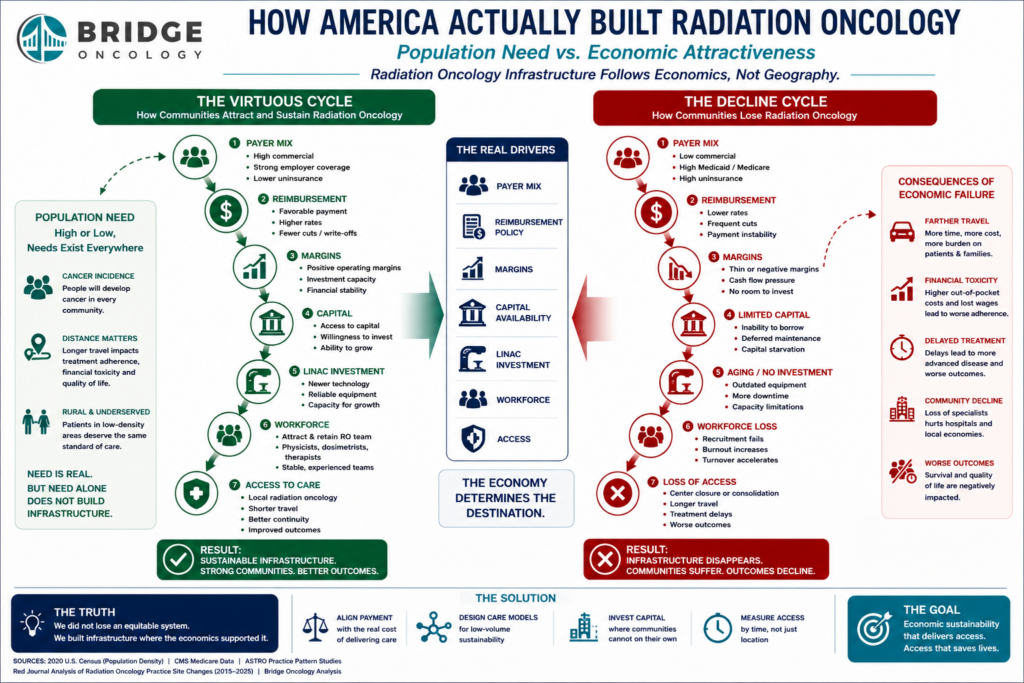
Our national analysis demonstrates why payer mix deserves considerably more attention in the access discussion. Communities with stronger employer-sponsored insurance tend to demonstrate greater capital investment, higher LINAC density, stronger recruitment capacity, more frequent equipment replacement, and lower closure rates. Conversely, markets dominated by government reimbursement frequently experience greater financial pressure despite having legitimate clinical need.
This fundamentally changes how we should interpret today’s access maps.
They are not simply maps showing where cancer care is available or unavailable.
They are also maps showing where healthcare capital has historically been able to survive.
Radiation Oncology Was Built for a Different Economic Era
The problem has become more pronounced because radiation oncology itself has changed dramatically.
Much of the infrastructure operating today was developed during an era when patients routinely received 35 to 45 radiation treatments. High treatment volumes generated predictable utilization and revenue capable of supporting expensive equipment, specialized personnel, technology investments, and ongoing capital replacement.
Then the clinical science improved.
Hypofractionation allowed many patients to receive equally effective treatment in substantially fewer visits. This has been an important advancement for patients because it can reduce travel, treatment burden, time away from work and family, and overall healthcare utilization.
However, the underlying cost structure did not decline proportionally.
Linear accelerators remain expensive. Service contracts have increased. Software costs have expanded. Cybersecurity has become essential. Labor costs have risen. Prior authorization has evolved into a permanent administrative infrastructure. Regulatory and compliance requirements continue to increase.
Radiation oncology therefore accomplished something healthcare has been demanding for years: it became more clinically efficient.
Unfortunately, much of its economic model remained dependent upon the utilization assumptions of an earlier era.
Bridge Oncology’s analysis has repeatedly highlighted this contradiction. Treatment volumes have declined while many of the fixed costs required to safely deliver radiation therapy have remained constant or increased.
That mismatch becomes particularly dangerous in lower-volume markets.
Access Is Usually the Last Domino to Fall
A radiation oncology program rarely becomes unsustainable on the day it closes.
The deterioration typically begins years earlier.
Margins gradually compress, making capital investment more difficult. Equipment replacement is postponed. Technology upgrades are delayed. Vacant positions become harder to fill. Maintenance costs increase as infrastructure ages. Recruitment becomes more difficult. Competitive position weakens, potentially contributing to declining referrals and additional margin pressure.
Eventually, leadership confronts a major capital decision and must determine whether investing millions of additional dollars into that market can be financially justified.
When the answer becomes no, consolidation or closure may follow.
Only then does the deterioration become visible to patients as an access problem.
Our analysis describes this progression as a predictable cycle in which declining margins lead to deferred investment, aging infrastructure, reduced competitiveness, lower volume, additional financial pressure, and ultimately program closure.
This is why access should be understood as the endpoint of the economic cycle rather than the beginning of it.
Radiation Oncology Is Not Alone
Perhaps the strongest evidence for this argument is what is happening outside radiation oncology.
Many of the same communities losing radiation oncology services are also experiencing rural hospital closures, physician shortages, reductions in obstetric services, trauma center instability, and declining access to other specialty services.
These services do not all operate under the same reimbursement methodology.
Yet they are struggling in many of the same markets.
That suggests a larger structural problem.
Healthcare infrastructure becomes difficult to maintain when population volume, payer mix, workforce availability, operating margins, and access to capital cannot support the cost of delivering the service.
Radiation oncology may simply reveal this problem earlier because it is among the most capital-intensive specialties in medicine.
Access Should Be Measured Differently
None of this means that geographic access should be ignored. Patients should not be required to travel unreasonable distances for essential cancer treatment.
However, whether a county contains a radiation oncology practice is an incomplete measure of meaningful access.
Counties are administrative boundaries rather than healthcare markets. They vary dramatically in geographic size, population density, transportation patterns, cancer incidence, and proximity to neighboring treatment centers.
A sparsely populated county without a LINAC may have reasonable access to a neighboring treatment center, while a county containing a radiation oncology facility may still have inadequate access because of workforce shortages, capacity constraints, insurance participation, transportation barriers, or financial instability.
A more sophisticated national access framework should therefore evaluate population density, cancer incidence, drive time, available LINAC capacity, payer mix, insurance participation, equipment age, workforce availability, hospital financial performance, and capital replacement requirements together.
The goal should not simply be placing a linear accelerator in every geographic area.
The goal should be ensuring that patients have reasonable access to sustainable treatment capacity.
More Reimbursement Alone Will Not Solve the Problem
This distinction also matters enormously for payment policy.
If we define the problem exclusively as access, the intuitive solution is to build or preserve more facilities. If we define it exclusively as reimbursement, the intuitive solution is to increase payment.
Neither strategy alone necessarily creates sustainability.
Placing a multimillion-dollar linear accelerator into an economically unsustainable market may improve access temporarily, but it also starts another capital replacement cycle. Eventually that equipment will require significant reinvestment.
Similarly, increasing reimbursement without addressing the total cost of care may improve margins while allowing vendor pricing, software expenses, service contracts, labor costs, administrative requirements, and inefficient workflows to continue escalating.
This is why Bridge Oncology has been so focused on total cost of care rather than reimbursement alone.
The future requires simultaneously examining what we pay for cancer care and what it actually costs to deliver it.
A Different Model for Community Radiation Oncology
If traditional radiation oncology economics cannot sustain conventional infrastructure in every market, the answer should not automatically be abandonment or consolidation.
The delivery model itself must evolve.
Regional networks can distribute fixed costs across multiple communities. Centralized treatment planning and remote dosimetry can improve workforce utilization. Enterprise physics models can allow scarce professional resources to support multiple locations. Direct Virtual Supervision can create additional flexibility where clinically and legally appropriate. Artificial intelligence and automation can reduce administrative and planning burden rather than simply adding another technology expense.
Payment models should similarly recognize that a low-volume rural program cannot necessarily be evaluated under the same assumptions as a high-volume metropolitan center. Market density, realistic treatment volume, payer mix, workforce conditions, capital requirements, and the minimum infrastructure necessary to safely maintain local treatment should become part of the sustainability discussion.
These approaches represent a fundamentally different objective from simply protecting the historical radiation oncology delivery model.
The objective should be designing the next model.
The Evidence Is Catching Up With the Conversation
Bridge Oncology has been willing to challenge the prevailing access narrative because solving the problem requires understanding what created it.
The emerging evidence does not suggest that access is unimportant. It suggests that access cannot be separated from the economics that produce it.
The national pattern is becoming increasingly difficult to ignore. Payer mix influences revenue. Revenue contributes to operating margin. Margin influences access to capital. Capital determines whether organizations can replace equipment and invest in technology. Investment supports workforce and infrastructure, and sustainable infrastructure ultimately determines whether patients continue to have local access to care.
The same relationship operates in reverse. Weak economics compress margins, constrained margins limit capital, inadequate capital leads to deferred investment, aging infrastructure contributes to operational and workforce instability, and eventually consolidation or closure occurs.
The access problem appears at the end of that process.
The Conversation Must Move Upstream
The future of radiation oncology policy should therefore move beyond documenting where facilities have disappeared and begin asking why the financial conditions necessary to sustain those facilities deteriorated.
That means examining reimbursement, but it also means confronting vendor costs, administrative burden, workforce models, utilization changes, capital replacement, payer mix, technology expenses, operational efficiency, and the total cost of delivering a radiation oncology episode.
Most importantly, it means acknowledging that the American radiation oncology delivery system was never constructed according to population need alone. Like much of American healthcare, infrastructure followed the economic conditions capable of supporting investment.
That system produced extraordinary technology and some of the most advanced cancer treatment in the world, but it also created structural vulnerability in communities where the economics were weaker.
The emerging evidence increasingly supports what Bridge Oncology has been arguing: we cannot preserve access without first understanding and repairing the economic foundation beneath it.
The question facing radiation oncology is therefore no longer simply where another center may close or how many Americans live in counties without a treatment facility. The more important question is whether the industry is prepared to redesign the economic model before additional communities reach that point.
At Bridge Oncology, we believe that is where the next phase of the conversation must begin.
Sustainable economics create sustainable infrastructure, and sustainable infrastructure creates durable access.