

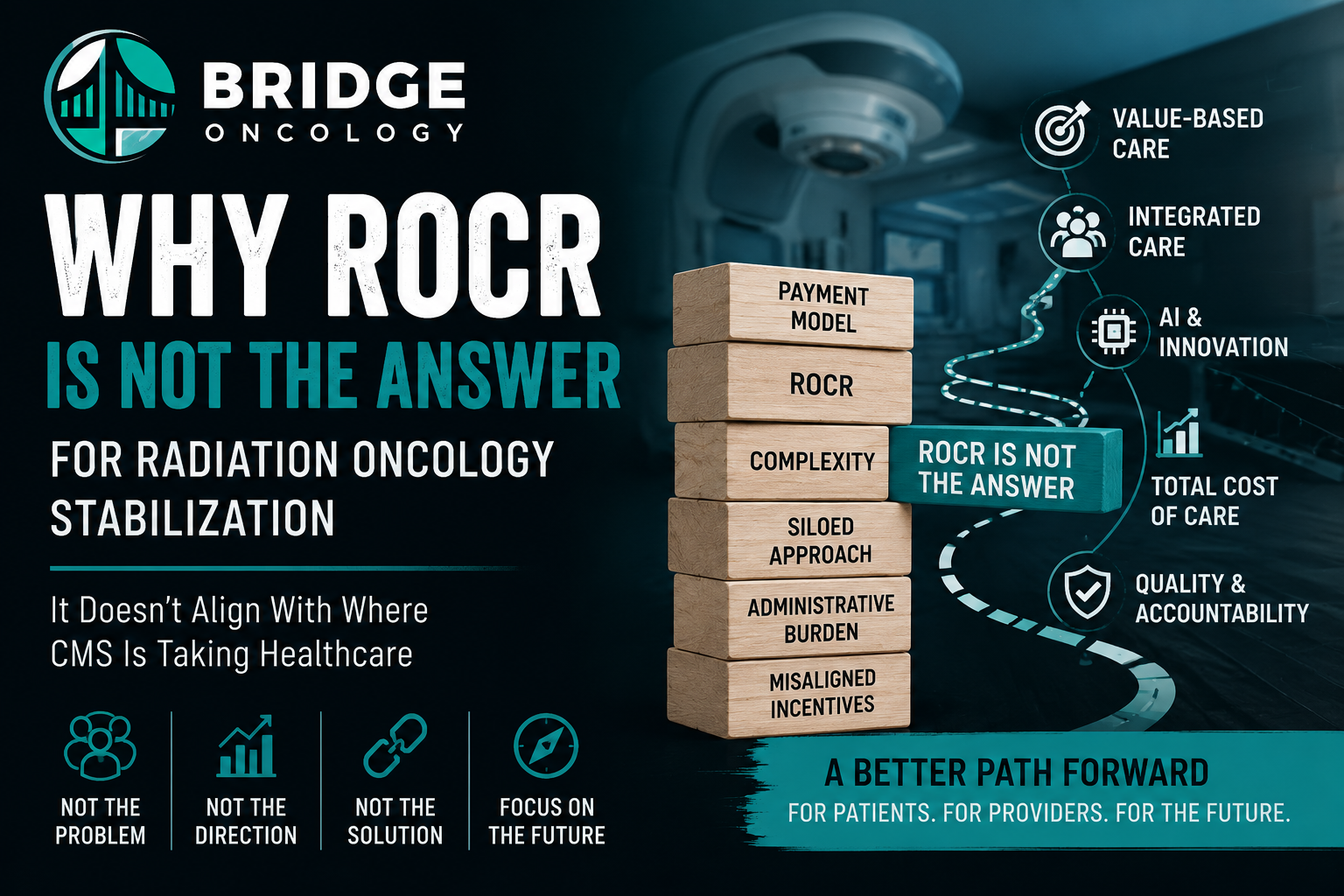
Why ROCR Is Not the Answer for Radiation Oncology Stabilization
The discussion surrounding ROCR radiation oncology has gained significant momentum as practices continue searching for solutions to declining reimbursement, rising operating costs, workforce shortages, and increasing administrative burden. The goal of the Radiation Oncology Case Rate (ROCR) model is understandable—it seeks to create greater payment predictability for radiation oncology providers.
However, payment stability alone will not stabilize the specialty.
When comparing the ROCR radiation oncology proposal with the policy direction outlined in the 2027 Medicare Physician Fee Schedule (MPFS) and Hospital Outpatient Prospective Payment System (OPPS) Proposed Rules, it becomes clear that CMS is moving in a very different direction. Rather than building additional specialty-specific payment models, CMS continues emphasizing integrated care delivery, total cost of care, digital transformation, artificial intelligence, and accountability across the entire oncology continuum.
For that reason, we believe ROCR does not represent the long-term future of radiation oncology.
The Real Challenge Facing Radiation Oncology
The challenges facing radiation oncology extend well beyond reimbursement. Community practices and hospital-based cancer programs continue to struggle with staffing shortages, delayed prior authorizations, physician recruitment, documentation requirements, workflow inefficiencies, revenue cycle leakage, and increasing regulatory oversight.
These operational challenges affect every patient encounter and every treatment course.
Changing reimbursement from fee-for-service to a case-rate payment model does not eliminate those inefficiencies. A department that struggles with scheduling delays, treatment planning bottlenecks, staffing shortages, or documentation deficiencies today will continue facing those same challenges under ROCR radiation oncology.
Financial stability begins with operational excellence. Payment methodology alone cannot solve operational problems.
CMS Is Moving Beyond Specialty Payment Models
One of the strongest themes throughout the 2027 CMS Proposed Rules is the continued transition toward integrated healthcare.
CMS continues expanding initiatives surrounding Accountable Care Organizations (ACOs), the Medicare Shared Savings Program (MSSP), value-based care, digital quality measurement, physician accountability, artificial intelligence, and total cost of care.
Cancer care is increasingly viewed as a coordinated service line rather than a collection of independent specialties.
Medical oncology, radiation oncology, surgery, pharmacy, imaging, navigation, supportive care, and survivorship are expected to work together to improve patient outcomes while reducing unnecessary costs.
This broader strategy differs significantly from the philosophy behind ROCR radiation oncology, which focuses primarily on how one specialty is reimbursed rather than how the entire oncology ecosystem performs.
ROCR Creates Another Radiation Oncology Silo
Healthcare is becoming more integrated every year.
Hospitals and health systems are investing heavily in multidisciplinary cancer centers, coordinated physician alignment, shared clinical pathways, and enterprise-wide performance measurement.
ROCR moves in the opposite direction.
Instead of integrating radiation oncology more closely into the overall oncology service line, ROCR radiation oncology creates another specialty-specific reimbursement methodology. While well-intentioned, this approach risks reinforcing departmental silos at the very time CMS is encouraging greater collaboration across the continuum of care.
The future of oncology depends on integration—not isolation.
Technology Is Changing Radiation Oncology Faster Than Payment Reform
Another reason ROCR radiation oncology may struggle to remain relevant is the extraordinary pace of technological innovation.
The 2027 CMS Proposed Rules devote substantial attention to artificial intelligence, Software as a Medical Service (SaMS), digital quality reporting, interoperability, physician oversight, and AI governance.
Radiation oncology is already experiencing rapid adoption of AI-assisted contouring, treatment planning, documentation support, imaging analysis, workflow automation, and predictive analytics.
These innovations are fundamentally changing how cancer care is delivered.
Future payment systems must remain flexible enough to accommodate rapidly evolving technology. Static reimbursement methodologies developed years earlier may not be able to support the speed of innovation that oncology is now experiencing.
Administrative Burden Will Continue
Many advocates of payment reform hope that episode-based reimbursement will reduce administrative complexity.
Unfortunately, administrative work rarely disappears—it simply changes form.
Disease-specific case rates require episode definitions, patient attribution, quality measurement, reconciliation methodologies, compliance oversight, and ongoing reporting.
Healthcare organizations would likely continue managing prior authorizations, payer policies, documentation requirements, compliance activities, and operational workflows while simultaneously administering a new reimbursement methodology.
The administrative burden facing radiation oncology is driven more by fragmented processes than by fee-for-service billing itself.
Workforce Sustainability Remains the Greatest Risk
Perhaps the greatest threat to radiation oncology is not reimbursement.
It is people.
Across the country, cancer centers continue struggling to recruit radiation therapists, dosimetrists, physicists, nurses, physicians, administrators, and revenue cycle professionals.
Burnout continues increasing while departments operate with fewer resources and greater clinical complexity.
ROCR radiation oncology does not directly address workforce sustainability.
Long-term stabilization requires investments in staffing efficiency, technology, workflow redesign, automation, leadership development, and operational support that allow clinicians to spend more time caring for patients and less time managing administrative processes.
A Better Path for Radiation Oncology
Rather than creating another isolated payment methodology, radiation oncology should continue aligning itself with the strategic direction CMS is already communicating through its proposed rules.
Future oncology reimbursement should encourage integrated cancer care, disease-specific clinical pathways, intelligent prior authorization processes, digital quality measurement, responsible artificial intelligence, operational analytics, revenue integrity, and multidisciplinary accountability.
These principles support the broader transformation occurring throughout Medicare while allowing radiation oncology to remain an essential component of coordinated cancer care.
The future belongs to organizations that improve quality, efficiency, patient access, and total cost of care—not simply those that change how claims are paid.
The Future of Radiation Oncology Requires More Than ROCR
The discussion surrounding ROCR radiation oncology has helped advance important conversations about the financial challenges facing the specialty. Those concerns are real and deserve meaningful solutions.
However, the healthcare system CMS is building extends well beyond specialty-specific payment reform.
The 2027 Medicare Proposed Rules consistently emphasize integrated care, artificial intelligence, digital transformation, physician accountability, value-based reimbursement, and total cost of care. Those themes appear throughout both the MPFS and OPPS proposals and provide a clearer picture of where Medicare intends to go over the next decade.
At Bridge Oncology, we believe the long-term stabilization of radiation oncology will come through operational excellence, integrated oncology service lines, responsible technology adoption, strong clinical governance, and financial strategies that align with the future of Medicare—not simply through another payment model.
As the specialty continues to evolve, success will belong to organizations that prepare for where healthcare is going, not where it has been.